
In today’s enterprise environments, identity has become the new security perimeter. As organizations continue to adopt hybrid infrastructures, cloud services, and remote work models, protecting user identities has become just as important as securing networks and endpoints. At the center of most Windows-based enterprise environments lies Microsoft Active Directory (AD), a directory service that acts as the foundation for authentication, authorization, and centralized system management.
Every day, millions of employees log into Windows computers, access shared folders, connect to corporate applications, and authenticate to business-critical services through Active Directory without ever realizing the complexity of the infrastructure working behind the scenes. Active Directory quietly validates identities, enforces security policies, grants access to resources, and ensures that only authorized users can interact with enterprise systems. Because virtually every Windows service depends on this trust relationship, Active Directory has evolved into one of the most critical components of an organization’s cybersecurity architecture.
Unfortunately, this central role also makes it one of the most attractive targets for attackers. Modern ransomware groups, advanced persistent threat (APT) actors, and insider threats rarely focus on compromising a single workstation for long-term objectives. Instead, they aim to compromise Active Directory because gaining control of the directory effectively grants control over the entire Windows environment. Once attackers obtain privileged access to the domain, they can impersonate users, modify security policies, distribute malicious software, disable security controls, and establish persistence throughout the network.
For this reason, protecting Active Directory is no longer simply a system administration responsibility—it is a strategic cybersecurity priority. Organizations that fail to secure their directory services expose themselves to data breaches, ransomware attacks, financial losses, and operational disruptions that can affect every department within the enterprise.
This article explores how Windows Active Directory functions, why it is frequently targeted by attackers, the techniques commonly used to compromise it, and the security practices organizations should implement to protect one of their most valuable assets.
What Is Windows Active Directory?
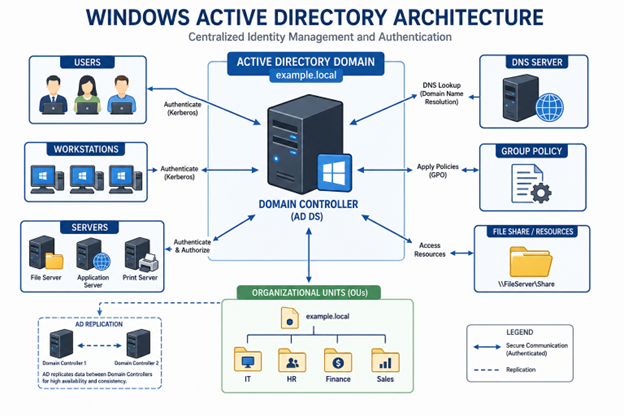
Active Directory is Microsoft’s centralized directory service that stores and manages information about every object within a Windows domain. Introduced with Windows Server 2000, it was designed to replace decentralized account management with a scalable identity management platform capable of supporting thousands—or even millions—of users across large enterprise networks.
Instead of maintaining separate user accounts on every workstation or server, Active Directory centralizes identity management by maintaining a secure directory database. This database contains information about users, computers, printers, groups, applications, security policies, and many other network resources. Every object within the directory possesses unique attributes, allowing administrators to efficiently organize, manage, and secure enterprise environments from a single location.
The heart of this system is the Domain Controller (DC). A Domain Controller hosts the Active Directory database and performs authentication whenever a user attempts to access a domain resource. Rather than storing credentials locally on individual machines, Windows systems communicate with the Domain Controller whenever authentication is required. This centralized approach simplifies administration while ensuring consistent security policies across the organization.
Active Directory is built around several logical structures that work together to organize enterprise environments. A domain represents a collection of users, computers, and resources that share a common security database. Multiple domains can be grouped into a forest, which serves as the highest security boundary within Active Directory. Within each domain, administrators organize users and computers into Organizational Units (OUs), allowing security policies to be applied to specific departments such as Human Resources, Finance, or Information Technology.
Another critical component is Group Policy, which allows administrators to centrally configure security settings, software deployment, password policies, firewall rules, Windows updates, and many other operating system configurations. Instead of manually configuring hundreds of computers individually, administrators create policies once and automatically distribute them throughout the enterprise. This capability significantly reduces administrative overhead while improving security consistency across the organization.
Because every authentication request, security policy, and permission assignment ultimately depends on Active Directory, the integrity of the directory directly affects the security of the entire organization.
How Authentication Works in Active Directory
One of Active Directory’s most important responsibilities is authenticating users before they are granted access to enterprise resources. Although the process appears instantaneous from the user’s perspective, several security mechanisms work together behind the scenes to verify identity while protecting sensitive credentials from exposure.
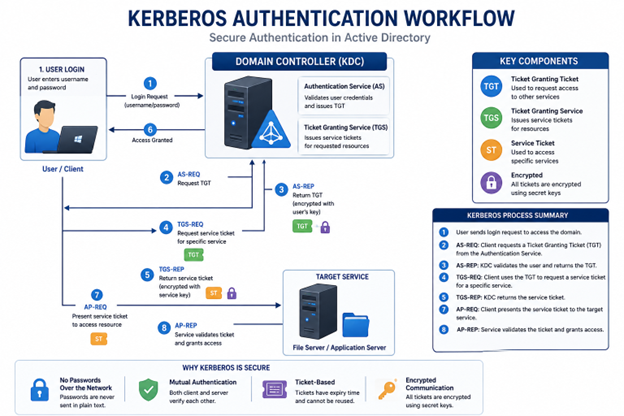
When a user enters a username and password at the Windows login screen, those credentials are not transmitted directly across the network in plain text. Instead, the client computer communicates securely with the Domain Controller using the Kerberos authentication protocol, which has been the default authentication mechanism in Active Directory since Windows 2000.
Kerberos is based on a ticketing system rather than repeatedly transmitting passwords. After successfully verifying the user’s credentials, the Domain Controller issues a Ticket Granting Ticket (TGT). This ticket acts as proof that the user has already been authenticated. Whenever the user later requests access to another network resource, such as a file server or SQL database, the client presents the TGT to obtain a Service Ticket specific to the requested service. Because these tickets contain encrypted authentication information, users can access multiple resources without repeatedly entering their passwords.
This design provides both convenience and security. Passwords remain protected, authentication traffic is encrypted, and replay attacks become significantly more difficult. Additionally, Kerberos uses mutual authentication, meaning that both the client and the server verify each other’s identities before establishing trust. This greatly reduces the risk of impersonation attacks compared to older authentication protocols such as NTLM.
Authentication, however, is only the first stage of the access process. Once a user’s identity has been verified, Active Directory proceeds to authorization, determining exactly which files, applications, printers, databases, and administrative functions that user is permitted to access. Authorization decisions are based on security groups, access control lists (ACLs), and Group Policy settings configured throughout the domain.
This separation between authentication and authorization allows organizations to enforce the principle of least privilege, ensuring that users receive only the permissions necessary to perform their responsibilities while minimizing the potential impact of compromised accounts.
Why Active Directory Is the Primary Target for Cyber Attackers
Active Directory is often described as the “keys to the kingdom,” and for good reason. Unlike a traditional application that serves a single business function, Active Directory governs identity and trust across an entire Windows environment. Every user account, computer, server, and administrative privilege ultimately depends on the directory service to determine who can access what. This central role means that compromising Active Directory provides attackers with far greater value than compromising individual endpoints.
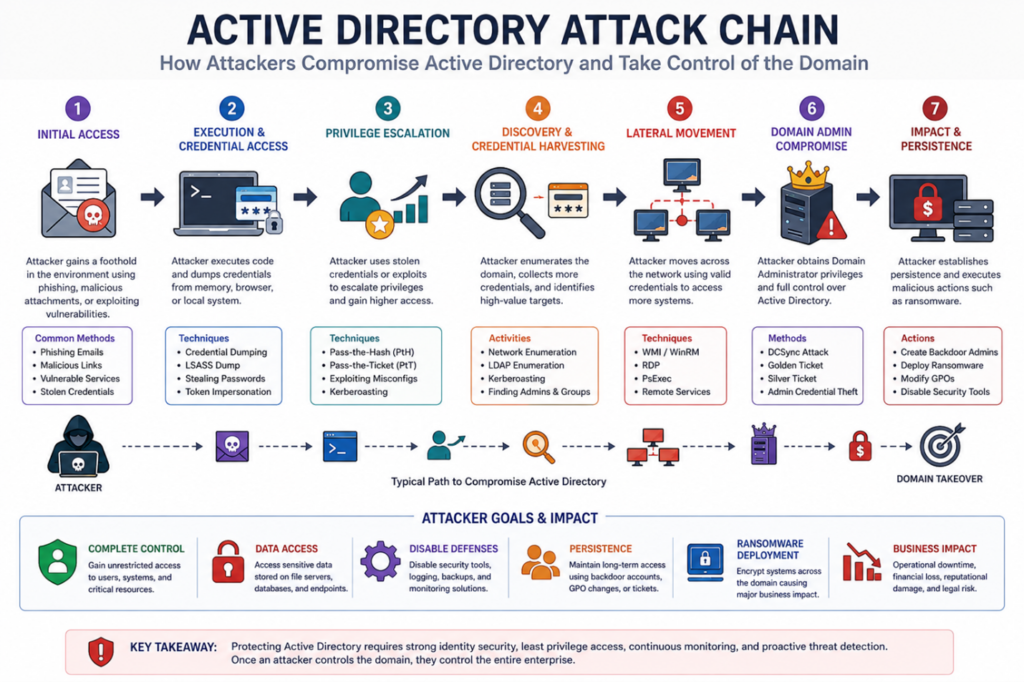
In many modern attacks, threat actors do not immediately attempt to breach the Domain Controller. Instead, they begin with a relatively low-privileged user account obtained through phishing, credential theft, or exploitation of a vulnerable workstation. From there, they spend time understanding the environment, identifying privileged users, mapping trust relationships, and collecting credentials. Their objective is to gradually increase their privileges until they gain administrative control over the domain.
Once Domain Administrator privileges are obtained, the security boundaries that protect the organization begin to disappear. Attackers can create new administrative accounts, reset user passwords, disable antivirus software through Group Policy, distribute ransomware to thousands of systems simultaneously, access confidential business information, and establish persistence mechanisms that survive password changes and system reboots. Because all domain-joined systems inherently trust the Domain Controller, malicious actions originating from privileged domain accounts often appear legitimate unless advanced monitoring solutions are in place.
For ransomware operators, compromising Active Directory is frequently the final objective before encryption begins. Instead of encrypting isolated systems one at a time, attackers use the centralized management capabilities of Active Directory to deploy ransomware across hundreds or thousands of endpoints simultaneously. This dramatically increases operational disruption and places greater pressure on organizations to pay ransom demands.
Active Directory is therefore much more than an identity management platform—it is the foundation upon which the security of an entire Windows enterprise is built. Protecting it is essential because its compromise almost always leads to widespread organizational compromise.
Understanding Common Active Directory Attack Techniques
Modern attacks against Active Directory rarely rely on a single vulnerability. Instead, attackers combine multiple techniques to exploit weaknesses in authentication, privilege management, and trust relationships. Understanding these attack methods is essential because effective defense begins with understanding how adversaries operate.
One of the earliest objectives after compromising a workstation is obtaining additional credentials. Windows stores authentication information within the Local Security Authority Subsystem Service (LSASS) to facilitate user authentication. Attackers frequently target this process because it may contain password hashes, Kerberos tickets, or cached credentials belonging to users who have previously logged into the system. Tools such as Mimikatz have demonstrated how valuable these credentials can be when defensive controls are absent.
A particularly well-known technique is Pass-the-Hash (PtH). Rather than attempting to crack a user’s password, attackers simply steal the NTLM password hash stored in memory and use it directly for authentication. Since Windows accepts the hash as proof of identity, the attacker gains access without ever knowing the actual password. This technique highlights why protecting credential storage is just as important as enforcing strong password complexity.
Another common attack is Kerberoasting, which exploits the Kerberos authentication process itself. Service accounts configured with Service Principal Names (SPNs) receive encrypted service tickets from the Domain Controller. Attackers can request these tickets without requiring elevated privileges and then perform offline password-cracking attacks against the encrypted ticket. If the service account uses a weak or predictable password, the attacker may recover it within a relatively short period. Because service accounts often possess elevated privileges and rarely have their passwords changed, Kerberoasting remains one of the most effective techniques for privilege escalation.
As attackers continue to expand their access, they often attempt to move laterally throughout the environment. Lateral movement involves using compromised credentials to authenticate to additional systems, allowing attackers to gradually approach high-value assets such as file servers, database servers, and Domain Controllers. Administrative tools such as Remote Desktop Protocol (RDP), Windows Management Instrumentation (WMI), PowerShell Remoting, and PsExec are frequently abused because they are legitimate administrative utilities commonly found within enterprise environments.
Among the most dangerous attacks targeting Active Directory is the DCSync attack. Normally, Domain Controllers replicate directory information among themselves to maintain consistency throughout the environment. Attackers who obtain specific replication privileges can impersonate a Domain Controller and request password hashes for every user account in the domain. These hashes include those belonging to Domain Administrators and even the highly sensitive KRBTGT account, making DCSync one of the most serious threats to Active Directory security.
The compromise of the KRBTGT account enables another devastating technique known as the Golden Ticket attack. Since the KRBTGT account is responsible for signing Kerberos Ticket Granting Tickets, possession of its password hash allows attackers to forge completely valid authentication tickets. These forged tickets can grant virtually unlimited privileges, remain valid for extended periods, and often survive password resets performed on regular administrative accounts. As long as the KRBTGT hash remains unchanged, attackers can continue generating new tickets whenever necessary.
A related attack, known as the Silver Ticket attack, focuses on forging service tickets rather than Ticket Granting Tickets. Although its scope is more limited than a Golden Ticket, it can be more difficult to detect because communication with the Domain Controller is often unnecessary after the ticket has been created.
These attack techniques illustrate an important reality: Active Directory attacks are rarely based on software vulnerabilities alone. Instead, they frequently exploit weak administrative practices, excessive privileges, poor credential hygiene, and insufficient monitoring. Strengthening these areas significantly reduces an organization’s exposure to domain compromise.
Building a Secure Active Directory Environment
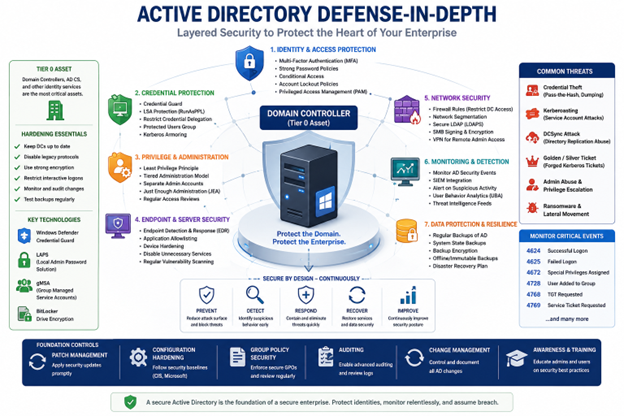
Securing Active Directory requires more than installing security software or applying occasional updates. Because the directory service governs every identity within the enterprise, organizations should adopt a layered security strategy that assumes attackers will eventually gain access to at least one system. The objective is not only to prevent compromise but also to limit the attacker’s ability to escalate privileges and move laterally.
The principle of least privilege forms the foundation of Active Directory security. Administrative permissions should be granted only when necessary and only for the duration required to complete specific tasks. Organizations should avoid using Domain Administrator accounts for routine administrative activities such as browsing the internet or checking email. Instead, administrators should maintain separate privileged accounts that are used exclusively for domain administration.
Modern versions of Windows provide several security technologies specifically designed to protect credentials. Windows Defender Credential Guard isolates sensitive authentication information using virtualization-based security, making credential theft significantly more difficult. Similarly, enabling LSA Protection (RunAsPPL) helps prevent unauthorized applications from accessing the LSASS process, reducing the effectiveness of credential dumping attacks.
Administrative passwords also deserve special attention. Shared local administrator passwords create unnecessary risk because compromising one system may allow attackers to access many others. Microsoft’s Local Administrator Password Solution (LAPS) addresses this problem by automatically assigning unique, regularly rotated passwords to local administrator accounts on every managed computer. Likewise, Group Managed Service Accounts (gMSAs) eliminate many of the weaknesses associated with traditional service accounts by automatically managing long, complex passwords without administrator intervention.
Organizations should also minimize their attack surface by disabling outdated authentication protocols such as LM, NTLMv1, and SMBv1, all of which contain known security weaknesses. Whenever possible, Kerberos should be used as the primary authentication mechanism because it provides stronger encryption, mutual authentication, and better resistance against replay attacks.
Another critical aspect of Active Directory security involves protecting the Domain Controllers themselves. These servers should be treated as Tier 0 assets, meaning they receive the highest level of protection within the organization. Only authorized administrators should have access to Domain Controllers, unnecessary software should never be installed, internet browsing should be prohibited, and security updates should be applied promptly after appropriate testing.
Security policies should also be regularly reviewed to ensure they continue to reflect current organizational requirements. Strong password policies, account lockout thresholds, privileged access management, and secure Group Policy configurations all contribute to reducing the likelihood of successful compromise.
Monitoring Active Directory for Suspicious Activity
Even the most secure Active Directory environment cannot rely solely on preventive controls. Continuous monitoring plays a vital role in detecting malicious activity before it develops into a full-scale compromise. Since attackers often spend days or even weeks moving laterally and escalating privileges, organizations that monitor authentication events and directory changes have a much greater chance of interrupting an attack before significant damage occurs.
Windows generates detailed security logs that record authentication attempts, privilege assignments, account creation, password resets, Group Policy modifications, and numerous other administrative activities. These logs become significantly more valuable when forwarded to a Security Information and Event Management (SIEM) platform such as Microsoft Sentinel, IBM QRadar, Splunk Enterprise Security, Wazuh, or Elastic Security. By correlating events from Domain Controllers, endpoints, firewalls, and endpoint detection solutions, security teams can identify abnormal behavior that may indicate credential theft or privilege escalation.
Certain Windows Security Event IDs deserve particular attention because they frequently appear during attacks against Active Directory.
| Event ID | Description |
| 4624 | Successful user logon |
| 4625 | Failed logon attempt |
| 4672 | Special privileges assigned to a new logon |
| 4728 | User added to a privileged security group |
| 4768 | Kerberos Ticket Granting Ticket requested |
| 4769 | Kerberos Service Ticket requested |
Monitoring these events individually is valuable, but correlating them provides a much clearer picture of attacker behavior. For example, repeated failed logons followed by a successful privileged logon and multiple Kerberos ticket requests may indicate credential compromise or lateral movement.
Conclusion
Windows Active Directory remains one of the most important components of enterprise cybersecurity because it serves as the central authority for identity, authentication, authorization, and policy enforcement across Windows environments. Its ability to simplify administration and provide centralized access management has made it indispensable for organizations of every size. At the same time, this central role has made it one of the most attractive targets for cybercriminals seeking complete control over enterprise infrastructure.
Protecting Active Directory requires far more than deploying antivirus software or enforcing complex passwords. Organizations must adopt a comprehensive defense strategy that combines secure authentication protocols, least-privilege administration, credential protection, hardened Domain Controllers, continuous monitoring, and regular security assessments. Technologies such as Credential Guard, LAPS, gMSAs, Multi-Factor Authentication, and SIEM-based monitoring significantly strengthen an organization’s ability to resist modern attacks.
As threat actors continue to evolve their techniques, Active Directory security should be viewed as an ongoing process rather than a one-time configuration task. Regular audits, timely patch management, proactive monitoring, and continuous improvement of security controls are essential for maintaining a resilient Windows environment. By investing in the protection of Active Directory, organizations safeguard not only their identity infrastructure but also the confidentiality, integrity, and availability of the entire enterprise.