
Cloud computing has fundamentally transformed how modern organizations build, deploy, and scale applications. Businesses are increasingly adopting public, private, and hybrid cloud environments to reduce infrastructure costs, accelerate software development, and improve business agility. Cloud service providers such as Amazon Web Services (AWS), Microsoft Azure, and Google Cloud Platform (GCP) offer highly resilient and scalable platforms capable of supporting workloads ranging from simple web applications to globally distributed enterprise systems.
However, while cloud adoption simplifies infrastructure management, it also introduces a completely new security paradigm. Traditional network-centric security models are no longer sufficient because cloud environments are highly dynamic. Resources are created and destroyed within minutes, workloads migrate across regions, users access services remotely, and infrastructure is managed through APIs rather than physical hardware.
This dynamic nature makes continuous security monitoring one of the most critical components of cloud security. Organizations cannot rely solely on preventive controls such as firewalls or access policies. Instead, they must continuously observe their cloud environments, detect suspicious behavior in real time, investigate security events, and respond before attackers can achieve their objectives.
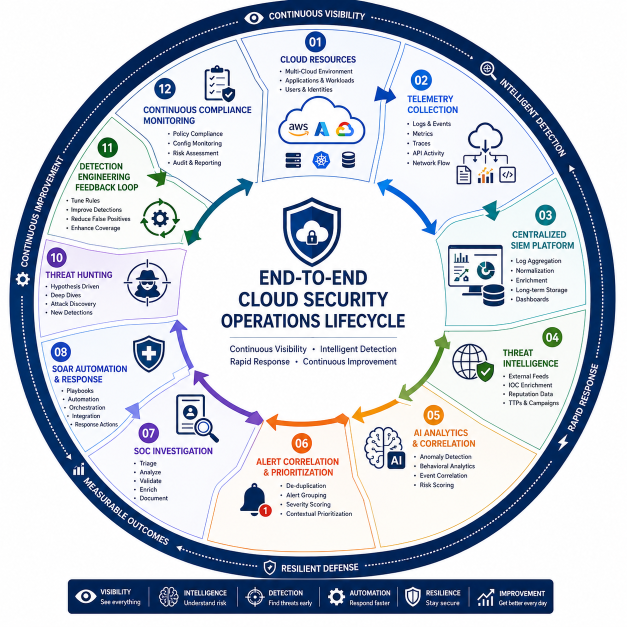
Security monitoring is no longer simply about collecting logs. It is about transforming millions of events into actionable intelligence that enables security teams to identify genuine threats while filtering out background noise. Modern cloud security operations centers (Cloud SOCs) depend on intelligent monitoring strategies that combine telemetry, threat intelligence, behavioral analytics, automation, and human expertise to maintain visibility across rapidly changing cloud infrastructures.
The Evolution of Cloud Security Monitoring
Traditional data centers were relatively static. Servers remained operational for months or years, IP addresses rarely changed, and security devices generated predictable log volumes. Security teams could manually investigate alerts because infrastructure changes occurred gradually.
Cloud computing changed this operational model completely.
Virtual machines can be deployed automatically within seconds. Containers may exist for only a few minutes before being replaced. Kubernetes clusters continuously scale applications up and down depending on workload demands. Serverless functions execute for milliseconds without maintaining persistent infrastructure.
These characteristics significantly increase monitoring complexity.
Instead of monitoring hundreds of systems, security teams may now monitor tens of thousands of cloud resources spread across multiple accounts, subscriptions, regions, and cloud providers. Every API call, authentication request, configuration change, storage operation, network connection, and workload execution can generate valuable security telemetry.
Without proper monitoring architecture, organizations lose visibility into their cloud environments and attackers can exploit this blind spot.
Modern cloud monitoring therefore focuses on maintaining continuous visibility rather than periodic security assessments.
Why Security Monitoring Matters in Cloud Environments
Cloud security follows the principle that prevention alone is insufficient. Even organizations with mature identity management, encryption, vulnerability management, and firewall policies must assume that attackers will eventually bypass preventive controls.
Continuous monitoring provides organizations with the ability to detect:
- Unauthorized access
- Credential theft
- Privilege escalation
- Data exfiltration
- Malware execution
- Insider threats
- Misconfigured cloud services
- Lateral movement
- Container compromise
- Cryptomining attacks
Early detection significantly reduces attacker dwell time.
Research consistently shows that attackers who remain undetected for weeks or months cause substantially greater financial and operational damage than those identified during the early stages of an intrusion.
Monitoring therefore becomes the foundation of modern incident response.
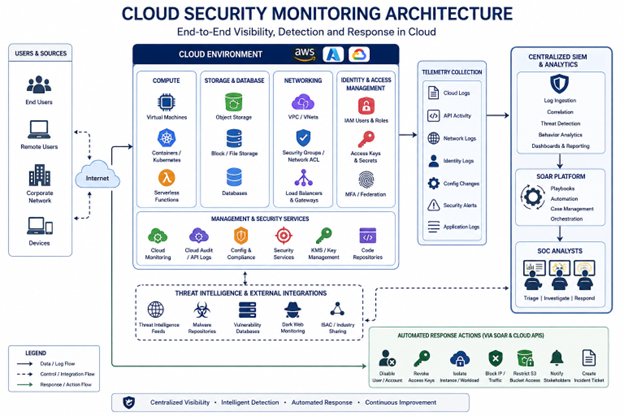
Understanding Cloud Telemetry: The Foundation of Cloud Security Monitoring
Security monitoring begins with visibility.
Visibility depends entirely on telemetry.
Telemetry refers to the operational and security data generated by cloud infrastructure, applications, operating systems, identity services, and network devices.
Unlike traditional environments where logs originated primarily from servers and firewalls, cloud infrastructures produce telemetry from numerous independent services.
Examples include:
Identity Logs
Identity logs capture authentication events, failed login attempts, multi-factor authentication challenges, privilege assignments, role assumptions, password changes, and federation activities.
These logs are often the first indicators of compromised credentials.
Network Logs
Cloud providers generate detailed network telemetry including:
- Virtual network traffic
- Security group changes
- Firewall events
- Flow logs
- Load balancer access logs
- VPN connections
- Internet gateway activity
These records help analysts identify lateral movement and suspicious communication patterns.
Compute Logs
Virtual machines generate:
- Operating system events
- Authentication logs
- Process execution
- File modifications
- System errors
- Security agent alerts
Container platforms additionally provide:
- Container lifecycle events
- Pod scheduling
- Kubernetes audit logs
- Cluster management activities
Storage Logs
Cloud storage services record:
- Object uploads
- File downloads
- Permission modifications
- Bucket configuration changes
- Public exposure events
- Encryption status changes
Storage telemetry plays a major role in detecting data exfiltration.
API Activity Logs
Nearly every cloud action occurs through APIs.
Examples include:
- Launching virtual machines
- Creating storage buckets
- Updating IAM policies
- Deploying applications
- Creating users
- Changing firewall rules
Monitoring API activity allows analysts to detect unauthorized administrative actions that might otherwise remain invisible.
Centralized Log Collection and SIEM Integration
One of the biggest challenges in cloud security is fragmentation.
Each cloud service generates logs independently.
Without centralized collection, analysts must investigate multiple dashboards, making incident response slower and less effective.
Modern security architectures therefore consolidate telemetry into centralized platforms such as SIEM solutions.
Centralization provides several advantages:
- Unified investigation workflows
- Cross-platform correlation
- Long-term log retention
- Regulatory compliance
- Threat hunting capabilities
- Automated alert generation
- Behavioral analytics
Instead of reviewing thousands of isolated events, analysts can correlate activity across identities, workloads, networks, and applications.
This holistic visibility dramatically improves detection accuracy.
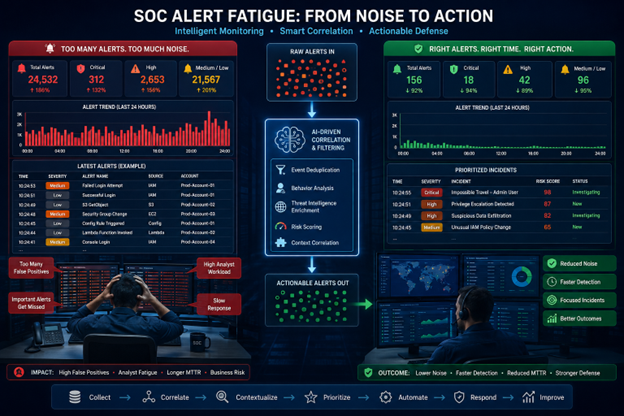
The Alert Fatigue Problem in Cloud SOCs
One of the greatest challenges facing Security Operations Centers is alert fatigue.
Cloud infrastructures generate enormous quantities of security events every day.
A medium-sized organization may produce millions of log entries every hour.
Only a tiny fraction represents genuine malicious activity.
Unfortunately, poorly tuned detection rules often generate thousands of false positives.
Examples include:
- Routine administrator logins
- Automated deployment scripts
- Scheduled vulnerability scans
- Backup operations
- Software updates
- Health monitoring services
If every event produces an alert, analysts become overwhelmed.
Over time they may begin ignoring notifications, delaying investigations, or missing genuine attacks hidden among the noise.
This phenomenon significantly reduces the effectiveness of security operations.
Turning alert noise into actionable defense requires intelligent detection engineering rather than simply collecting more logs.
Detection Engineering: Quality Over Quantity
Detection engineering is the process of designing high-quality security detections that accurately identify malicious behavior while minimizing false positives.
Rather than alerting on every failed login attempt, detection engineers build contextual rules.
For example:
A single failed login is rarely suspicious.
However, detection confidence increases significantly when multiple indicators occur together:
- Multiple failed login attempts
- Successful login immediately afterward
- Login from an unusual geographic location
- New device fingerprint
- Privilege escalation
- Creation of new access keys
- API activity inconsistent with historical behavior
Each individual event may appear harmless.
Combined together, they reveal a high-confidence attack pattern.
This correlation-based approach greatly improves SOC efficiency.
Behavioral Analytics in Cloud Monitoring
Traditional security monitoring relied heavily on known attack signatures.
Modern attackers frequently avoid signatures by using legitimate cloud services and stolen credentials.
Behavioral analytics addresses this limitation.
Instead of asking:
- Is this attack known?
- Behavioral monitoring asks:
- Is this activity normal?
Examples include:
An employee normally accesses cloud resources from Lahore between 9 AM and 6 PM.
If the same identity suddenly begins creating hundreds of virtual machines from another country at 3 AM, the activity becomes suspicious despite valid credentials.
Similarly:
- Unusual API usage
- Excessive data downloads
- Rare administrative commands
- Unexpected Kubernetes deployments
- Large IAM policy changes
can all indicate compromised accounts.
Behavioral analytics therefore focuses on deviations from established baselines rather than predefined attack signatures.
Threat Intelligence Integration for Cloud Security Monitoring
Cloud monitoring becomes significantly more effective when combined with external threat intelligence.
Threat intelligence provides continuously updated information about:
- Malicious IP addresses
- Known phishing domains
- Command-and-control servers
- Malware hashes
- Ransomware infrastructure
- Exploited vulnerabilities
- Nation-state attack campaigns
When SIEM platforms correlate internal telemetry with external intelligence, security teams gain valuable context.
For example, a single outbound connection may appear harmless.
If that destination IP is associated with an active ransomware campaign, the event immediately becomes high priority.
Threat intelligence therefore enhances both detection accuracy and investigation speed.
Security Automation and SOAR: Responding at Cloud Speed
Modern cloud environments operate at a pace that far exceeds the capabilities of manual security operations. Infrastructure is provisioned automatically through Infrastructure as Code (IaC), applications are deployed multiple times a day through CI/CD pipelines, and workloads dynamically scale based on demand. In such environments, waiting for a security analyst to manually investigate every alert is impractical.
This challenge has led organizations to adopt Security Orchestration, Automation, and Response (SOAR) platforms. SOAR solutions integrate with SIEM platforms, cloud APIs, endpoint protection tools, identity providers, vulnerability scanners, and ticketing systems to automate repetitive security tasks.
Instead of treating automation as a replacement for analysts, modern Cloud SOCs use SOAR to augment human decision-making. Analysts define playbooks that specify how particular alerts should be handled. When a predefined condition is met, the SOAR platform executes the appropriate workflow automatically.
For example, if a cloud identity generates multiple failed login attempts followed by a successful login from an unfamiliar geographic location, the automation workflow may:
- Retrieve contextual information about the user.
- Check whether the login originated from a known corporate device.
- Query threat intelligence feeds for the source IP address.
- Determine whether multi-factor authentication was completed.
- Create an incident ticket.
- Notify the security team.
- Temporarily disable the account if the risk score exceeds a defined threshold.
By automating repetitive investigations, analysts spend less time validating false positives and more time focusing on complex attacks that require human expertise.
Automation also improves consistency. Every alert is processed according to standardized procedures, reducing the possibility of human error during incident response.
AI and Machine Learning in Cloud Security Monitoring
As organizations migrate more workloads to the cloud, the volume of security telemetry continues to grow exponentially. Processing billions of log events every day is no longer feasible using traditional rule-based detection alone.
Artificial Intelligence (AI) and Machine Learning (ML) have become essential technologies for improving cloud security monitoring.
Machine learning models analyze historical activity to establish behavioral baselines for users, applications, devices, and cloud services. Rather than relying exclusively on predefined detection rules, these models continuously evaluate whether current behavior deviates from expected patterns.
Examples include identifying:
- Abnormal API usage
- Sudden increases in privileged operations
- Unusual virtual machine deployments
- Unexpected geographic login locations
- Large-scale data transfers
- Rare administrative commands
- Irregular Kubernetes management activities
Unlike signature-based systems, machine learning can identify previously unseen attack techniques by recognizing anomalies.
AI also assists security analysts by automatically correlating events originating from different cloud services. Instead of presenting hundreds of individual alerts, intelligent monitoring systems group related events into a single security incident with supporting evidence.
However, AI should not be viewed as a complete replacement for detection engineering. Poor-quality telemetry, misconfigured logging, or incomplete visibility can lead to inaccurate models. Effective cloud monitoring combines machine learning with carefully designed detection rules, threat intelligence, and analyst expertise.
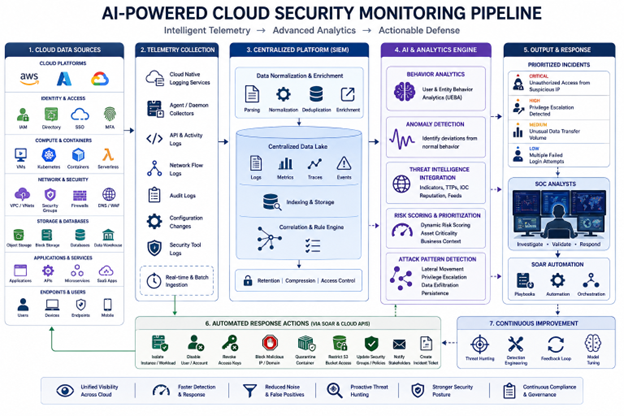
Proactive Threat Hunting in Cloud Environments
Traditional monitoring relies on alerts generated by predefined detection rules. Threat hunting takes a different approach by proactively searching for indicators of compromise that automated systems may have missed.
Cloud threat hunters begin with hypotheses based on attacker tactics, techniques, and procedures (TTPs). They use historical logs, cloud telemetry, endpoint data, identity records, and network traffic to validate these hypotheses.
For example, a threat hunter may investigate whether compromised credentials have been used to create unauthorized access keys within the cloud environment. Another investigation may focus on identifying workloads communicating with previously unseen external destinations or searching for unusual privilege escalation activities across cloud accounts.
Cloud-native services provide rich telemetry that greatly enhances threat hunting capabilities. Analysts can examine API call histories, identity activities, storage access records, Kubernetes audit logs, and network flow data to reconstruct attacker behavior over extended periods.
Threat hunting also supports continuous improvement of detection engineering. When hunters discover attacker techniques that bypass existing detection rules, new correlation logic can be developed to identify similar attacks in the future. This feedback loop strengthens the organization’s overall security posture and reduces the likelihood of repeated compromise.
Cloud Incident Response: A Step-by-Step Process
Detection alone does not prevent security incidents. Organizations must also respond quickly and effectively once malicious activity has been identified.
Cloud incident response differs significantly from traditional incident response because infrastructure is highly dynamic and often distributed across multiple geographic regions.
A structured cloud incident response process typically consists of the following phases:
Preparation
Organizations establish logging policies, deploy monitoring agents, configure SIEM and SOAR platforms, define response procedures, maintain forensic readiness, and ensure that cloud administrators understand their security responsibilities.
Identification
Security monitoring systems detect suspicious behavior using correlation rules, behavioral analytics, threat intelligence, or manual threat hunting.
Analysts validate alerts to determine whether they represent genuine security incidents.
Containment
The primary objective during containment is to limit attacker activity while preserving evidence.
Depending on the incident, responders may:
- Disable compromised accounts.
- Revoke access tokens.
- Isolate virtual machines.
- Restrict network communication.
- Quarantine containers.
- Block malicious IP addresses.
- Rotate exposed credentials.
Eradication
After containing the threat, responders remove malicious artifacts, patch exploited vulnerabilities, eliminate persistence mechanisms, update security policies, and verify that attacker access has been removed.
Recovery
Systems are restored to normal operation while security teams closely monitor for signs of recurring malicious activity. Recovery includes validating system integrity, restoring affected services, and ensuring business continuity.
Lessons Learned
Following incident closure, organizations conduct post-incident reviews to identify weaknesses in monitoring, detection engineering, security controls, and operational procedures. The findings are used to improve future defensive capabilities.
Continuous Compliance Monitoring
Security monitoring is not limited to detecting cyberattacks. It also plays a critical role in maintaining regulatory compliance.
Organizations operating in regulated industries must continuously verify that cloud resources comply with internal security policies and external standards such as ISO 27001, PCI DSS, HIPAA, SOC 2, or GDPR.
Continuous compliance monitoring automatically identifies security misconfigurations including:
- Publicly accessible storage buckets
- Disabled encryption
- Weak identity policies
- Excessive administrative privileges
- Inactive security logging
- Misconfigured network security groups
- Unpatched virtual machines
- Non-compliant container images
Unlike periodic compliance audits, continuous monitoring detects violations immediately after they occur, allowing organizations to remediate issues before they become security incidents or audit findings.
This proactive approach significantly reduces organizational risk while simplifying compliance reporting.
Best Practices for Turning Alert Noise into Actionable Defense
Building an effective cloud monitoring strategy requires more than deploying security tools. Organizations should adopt operational practices that maximize detection accuracy while minimizing unnecessary alerts.
Effective practices include:
- Collect telemetry from identity, network, compute, storage, applications, and cloud management services rather than relying on a single data source.
- Continuously tune detection rules to eliminate recurring false positives and improve alert quality.
- Prioritize alerts based on risk, asset criticality, user behavior, and business context instead of event volume.
- Correlate cloud events across multiple services to identify complete attack chains rather than isolated activities.
- Integrate external threat intelligence to enrich alerts with current attacker infrastructure and indicators of compromise.
- Automate repetitive investigations and low-risk response actions through SOAR playbooks.
- Perform proactive threat hunting to identify attacks that evade automated detections.
- Validate monitoring coverage after infrastructure changes to ensure new cloud resources are properly logged.
- Regularly test incident response procedures using realistic attack simulations and tabletop exercises.
- Measure key performance indicators such as Mean Time to Detect (MTTD), Mean Time to Respond (MTTR), false-positive rates, and detection coverage to continuously improve SOC performance.
Organizations that adopt these practices create monitoring programs focused on quality rather than quantity.
Emerging Trends in Cloud Security Monitoring
Cloud security monitoring continues to evolve as attackers develop increasingly sophisticated techniques.
Several technologies are shaping the future of cloud defense.
Extended Detection and Response (XDR) platforms combine endpoint, identity, email, network, and cloud telemetry into unified investigations. Cloud-Native Application Protection Platforms (CNAPP) integrate posture management, workload protection, vulnerability assessment, and runtime monitoring into a single security solution.
OpenTelemetry is becoming an industry standard for collecting telemetry consistently across applications, infrastructure, and cloud services. This standardization improves visibility while simplifying integration between monitoring platforms.
Artificial intelligence will continue to enhance behavioral analytics, automated investigations, and incident prioritization. Rather than replacing analysts, AI will increasingly function as a decision-support capability that accelerates investigation and response.
Zero Trust Architecture will also become more tightly integrated with cloud monitoring. Continuous verification of identities, devices, workloads, and access requests will generate additional telemetry that strengthens detection capabilities across modern cloud environments.
Organizations that embrace these innovations will be better equipped to defend increasingly complex cloud ecosystems.
Conclusion
Cloud computing has fundamentally changed the way organizations manage infrastructure, applications, and security. While the cloud provides unparalleled scalability and operational flexibility, it also generates vast volumes of security telemetry that can overwhelm even mature Security Operations Centers if not managed effectively.
Successful cloud security monitoring is no longer measured by the number of alerts generated but by the organization’s ability to convert raw telemetry into actionable intelligence. Achieving this objective requires centralized log collection, high-quality detection engineering, behavioral analytics, threat intelligence integration, automation, proactive threat hunting, and a disciplined incident response process.
Reducing alert noise is not simply a matter of suppressing notifications; it involves understanding organizational risk, continuously refining detection logic, and ensuring that every high-priority alert receives timely attention. Automation and artificial intelligence further enhance these efforts by accelerating investigations, prioritizing incidents, and enabling analysts to focus on sophisticated threats rather than repetitive tasks.
As cloud environments continue to expand in complexity, organizations that invest in intelligent monitoring strategies will be better positioned to detect attacks earlier, respond more effectively, maintain regulatory compliance, and strengthen their overall cyber resilience. Ultimately, transforming alert noise into actionable defense is the defining characteristic of a modern and effective cloud security program.