We maps your external attack surface to uncover exposed assets, shadow IT, and critical vulnerabilities. Fix your weak links with precision and confidence.
Automated tools generate data, not context. Identifying actual risk across your server infrastructure requires human analysis, not just a CVE checklist.
001.
Rely entirely on static signatures and version checking. They cannot chain vulnerabilities, test business logic, or validate if an exposed service is actually exploitable.
002.
Tasked with uptime and provisioning across diverse OS environments. They lack the offensive security background required to accurately interpret external attack surface telemetry.
003.
Recruiting a dedicated offensive security engineer capable of assessing complex, multi-OS server architectures is a massive and continuous capital expense.
Without a human-led assessment, critical misconfigurations and attack paths remain completely invisible until exploited.
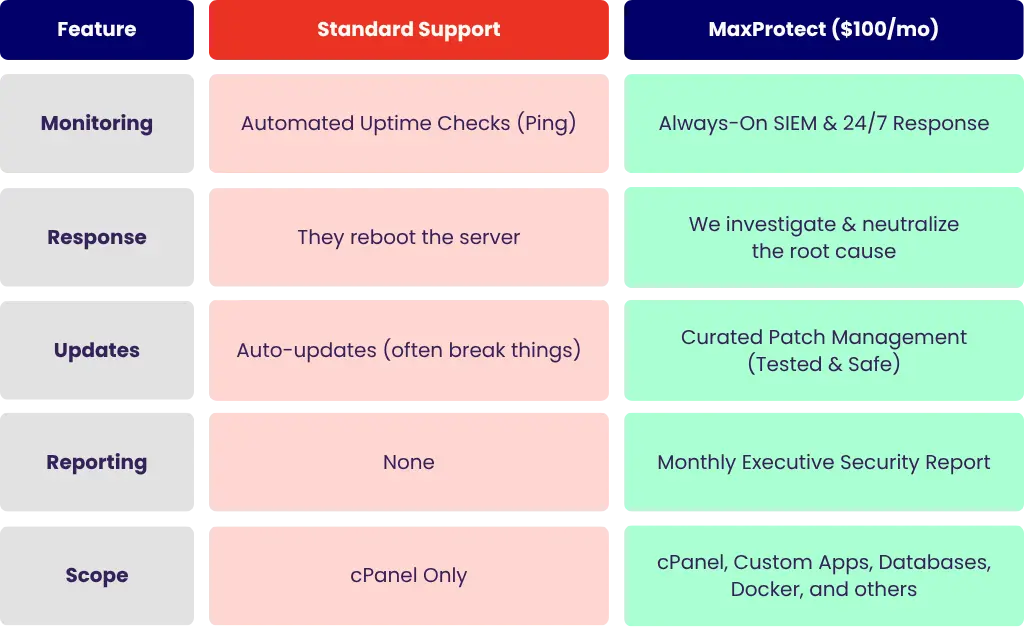
Hosting providers manage your uptime. We secure your infrastructure. Here is how our managed SOC compares to standard support.
Moving beyond basic management to proactive, zero-noise threat defense.
We don't wait for you to open a ticket. Our Security Operations Center (SOC) ingests logs from your servers in real-time. If we see suspicious behavior—like a brute-force attack or unauthorized root access—we intervene immediately.
We deploy advanced Endpoint Protection agents that go beyond standard antivirus. We detect malicious behavioral patterns in real-time, instantly identify and neutralize attacks,and stopping ransomware before it encrypts your data.
Hackers love unpatched servers. We perform monthly vulnerability scans to find weak points in your kernel, OS, or applications. Then, we manually apply patches during your maintenance window to ensure nothing breaks.
We provide a detailed monthly report showing exactly what we blocked, what we patched, and the current health of your infrastructure.
A security plan that fits your business size and protection requirements.
Includes:
See exactly where your servers stand. No credentials required.
⚠️ Audit Eligibility: This audit is specifically designed for Dedicated Servers, VPS, or Cloud Instances. We cannot perform audits on “Shared Hosting” accounts unless you are the owner/administrator of the entire physical or virtual server.
The document outlines actionable mitigation strategies and technical recommendations to strengthen defenses against unauthorized access and cyber threats.
An External Security Assessment maps out your public-facing digital footprint to uncover exposed assets, shadow IT, and critical system vulnerabilities. By analyzing your public IP addresses and domain configurations, MaxProtect finds exploitable security gaps—such as open database ports or unpatched server vulnerabilities—before malicious actors can find and weaponize them.
No. Our Free External Security Assessment requires absolutely zero credentials or internal access. We run our non-invasive evaluation entirely from an outside perspective (the same view an external attacker would have), allowing us to analyze your server’s public-facing security posture safely and transparently.
Automated scanners simply output long lists of static software versions and generic CVEs (Common Vulnerabilities and Exposures) without any practical context. Our certified security engineers manually analyze the scan telemetry to chain vulnerabilities, determine whether an open service is actually exploitable, and filter out false alarms so you can focus on resolving real, immediate risks.
No. This assessment is specifically designed for Dedicated Servers, Virtual Private Servers (VPS), or Cloud Instances (such as AWS, Azure, or OCI). Because shared hosting accounts share resources and public IP structures with hundreds of other websites, we cannot perform audits on them unless you are the administrator or owner of the entire physical or virtual server.

You will receive a comprehensive, actionable PDF report detailing your external server footprint. This includes verified open ports, exposed services, SSH configuration gaps, and high-priority vulnerabilities. Each identified risk is accompanied by clear, technical mitigation strategies and direct server-hardening recommendations.