
Servers are the foundation of modern enterprise infrastructure. They host business-critical applications, databases, authentication services, file storage, virtualization platforms, cloud workloads, and internal business processes. As organizations continue adopting hybrid cloud environments and distributed infrastructures, servers have become increasingly interconnected, making them one of the most valuable targets for cybercriminals.
While organizations invest heavily in firewalls, endpoint protection platforms, identity management solutions, and security monitoring, these controls alone cannot guarantee that servers remain resilient against evolving threats. Security controls must be continuously evaluated to ensure they perform as intended under real-world conditions. This validation process is known as Server Security Testing.
Server Security Testing is the systematic process of assessing servers for vulnerabilities, security misconfigurations, weak authentication mechanisms, excessive privileges, outdated software, exposed services, and other weaknesses that could be exploited by attackers. Rather than assuming security controls are effective, organizations actively verify their effectiveness through structured assessments and controlled testing activities.
In this blog, we will explore the importance of Server Security Testing, the methodologies used to evaluate server security, common attack vectors, and the best practices organizations can implement to validate their infrastructure before adversaries identify and exploit weaknesses.
Why Server Security Testing Matters
Enterprise environments continuously evolve. New servers are deployed, applications are updated, cloud resources are provisioned, administrative accounts are created, and security policies are modified to support changing business requirements. Each operational change has the potential to introduce new vulnerabilities or weaken existing security controls.
A server that was considered secure during deployment may gradually become exposed due to missing security updates, configuration drift, unnecessary services, weak access controls, or outdated software components. Without regular security validation, these issues often remain undetected until they are exploited by an attacker.
Server Security Testing provides organizations with an evidence-based understanding of their security posture. Instead of relying solely on preventive controls, testing verifies whether implemented safeguards effectively resist known attack techniques and unauthorized access attempts.
Regular testing enables organizations to identify weaknesses early, prioritize remediation efforts based on risk, reduce the attack surface, and improve overall cyber resilience. It also supports regulatory compliance by demonstrating that security controls are continuously assessed rather than implemented only once.
In mature security programs, server testing is not treated as a one-time activity but as an ongoing operational process integrated into infrastructure management and change control.
Understanding the Modern Server Threat Landscape
Cyber threats targeting servers have become significantly more sophisticated over the past decade. Modern attackers rarely depend on a single vulnerability. Instead, they combine multiple weaknesses—including stolen credentials, privilege escalation, misconfigurations, and unpatched software—to achieve their objectives.
Internet-facing servers are continuously scanned by automated tools searching for exposed services such as Remote Desktop Protocol (RDP), Secure Shell (SSH), web applications, VPN gateways, and database services. Public vulnerability disclosures often lead to rapid exploitation attempts within hours of patches being released.
Internal servers are equally attractive targets. Once attackers obtain an initial foothold within an organization, they frequently attempt lateral movement by compromising additional servers, escalating privileges, and accessing sensitive systems. Weak administrative practices, shared credentials, excessive permissions, and insufficient segmentation significantly accelerate these attacks.
Organizations must therefore validate both external and internal security controls to ensure servers remain resilient throughout every phase of the attack lifecycle.
Understanding the Server Attack Surface
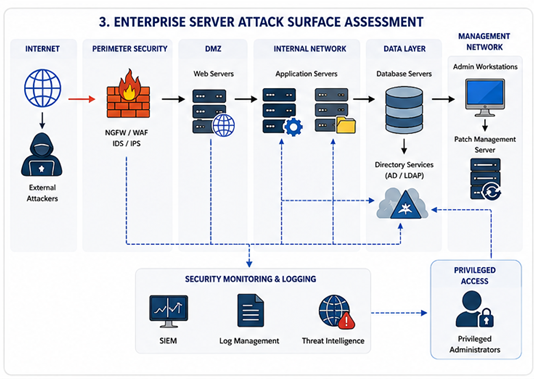
The attack surface represents every possible pathway through which an attacker can interact with or compromise a server. As enterprise infrastructures expand, the attack surface becomes increasingly complex and difficult to manage.
A typical enterprise server exposes multiple components that require continuous evaluation, including network services, operating systems, authentication mechanisms, administrative interfaces, APIs, scheduled tasks, virtualization platforms, service accounts, cloud integrations, and application frameworks.
Each exposed component introduces potential risk if it is improperly configured or insufficiently protected.
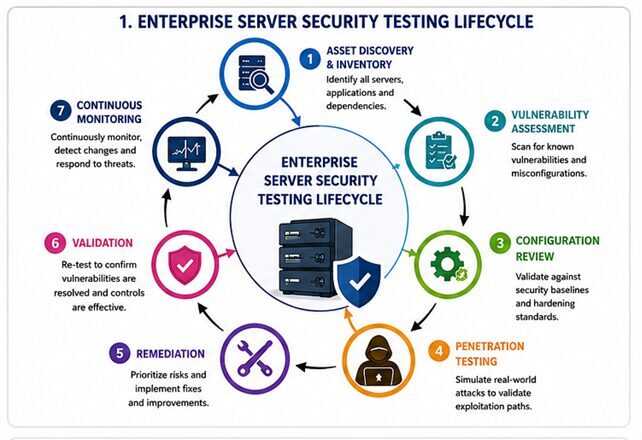
Effective Server Security Testing begins with accurately identifying every component that contributes to the attack surface. Asset discovery, service enumeration, operating system fingerprinting, and dependency mapping provide the visibility necessary to evaluate these assets systematically.
Organizations cannot secure infrastructure they do not know exists. Comprehensive asset visibility therefore forms the foundation of every successful server security assessment.
Security Testing as a Continuous Validation Process
Many organizations mistakenly associate security testing exclusively with annual penetration tests. While penetration testing remains valuable, modern cybersecurity requires continuous validation throughout the entire server lifecycle.
Security testing begins during system deployment by verifying secure baseline configurations. As servers transition into production, automated vulnerability scanning confirms that newly deployed software does not introduce known security weaknesses.
Configuration assessments validate compliance with organizational hardening standards, while privileged access reviews ensure administrative permissions remain appropriate. Following software updates or infrastructure changes, additional testing verifies that security controls continue functioning correctly.
This continuous validation model transforms security testing from a compliance exercise into an operational security function that actively supports risk management.
Organizations implementing continuous testing are better positioned to identify configuration drift, unauthorized changes, and emerging vulnerabilities before they become exploitable.
Types of Server Security Testing
Server Security Testing encompasses multiple assessment methodologies, each designed to evaluate different aspects of server security.
Vulnerability assessments identify known software vulnerabilities using automated scanning technologies and vulnerability databases. These assessments provide broad visibility across large environments and help organizations prioritize remediation based on severity and exploitability.
Configuration assessments evaluate whether servers comply with security best practices and organizational hardening standards. These reviews examine password policies, authentication settings, encryption configurations, unnecessary services, firewall rules, logging capabilities, and operating system parameters.
Penetration testing simulates real-world attacker behavior by attempting to exploit identified weaknesses under controlled conditions. Unlike vulnerability assessments, penetration testing demonstrates whether vulnerabilities can actually be leveraged to compromise systems or escalate privileges.
Authentication testing validates password policies, account lockout mechanisms, multi-factor authentication implementations, and privileged account protections to ensure unauthorized users cannot easily obtain administrative access.
Privilege escalation testing examines whether users with limited permissions can gain elevated access through operating system vulnerabilities, insecure configurations, or improper privilege assignments.
Each methodology contributes unique insights into the overall security posture, making them complementary rather than interchangeable.
Vulnerability Assessment vs. Penetration Testing
Although these terms are often used interchangeably, vulnerability assessments and penetration testing serve fundamentally different purposes.
A vulnerability assessment focuses on identifying known weaknesses across servers. Automated scanners compare installed software versions, configurations, and exposed services against vulnerability databases to determine whether systems are affected by publicly documented security issues. The objective is comprehensive visibility rather than exploitation.
Penetration testing, by contrast, seeks to determine whether identified vulnerabilities can be successfully exploited to compromise systems or gain unauthorized privileges. Security professionals combine technical expertise with attacker methodologies to validate real-world risk under controlled conditions.
A vulnerability assessment may identify hundreds of potential findings, whereas a penetration test demonstrates which of those findings represent practical attack paths capable of affecting business operations.
The most mature security programs perform both activities regularly, using vulnerability assessments for continuous monitoring and penetration testing to validate defensive effectiveness against realistic attack scenarios.
Configuration Review and Server Hardening Validation
A significant percentage of successful server compromises occur because of security misconfigurations rather than previously unknown software vulnerabilities. Modern operating systems include extensive security features; however, these protections are only effective when configured according to established security baselines. As servers evolve through software installations, administrative changes, and infrastructure updates, configurations often drift away from their original hardened state. This gradual deviation introduces unnecessary risk and increases the organization’s attack surface.
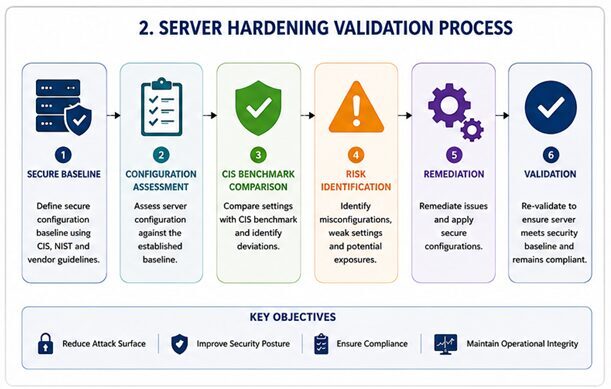
Configuration review is the process of evaluating a server against recognized security standards and organizational policies. The objective is to determine whether the operating system, installed applications, network services, and security controls are configured to minimize opportunities for unauthorized access.
Security professionals typically validate configuration settings against benchmarks published by organizations such as the Center for Internet Security (CIS), the National Institute of Standards and Technology (NIST), and vendor-specific hardening guides. These benchmarks provide detailed recommendations covering password policies, authentication mechanisms, encryption standards, service configurations, firewall rules, logging requirements, remote administration settings, and kernel security parameters.
During configuration assessments, security teams examine whether unnecessary services have been disabled, administrative interfaces are properly restricted, default accounts have been removed or secured, secure communication protocols are enforced, and logging mechanisms are functioning correctly. They also verify that security updates have not inadvertently altered previously hardened configurations.
Configuration reviews are particularly valuable because they identify weaknesses before they become exploitable. Unlike vulnerability scanning, which focuses primarily on known software flaws, configuration assessments evaluate the overall security posture of the operating environment.
Organizations that routinely validate server configurations significantly reduce the likelihood of successful attacks originating from human error, inconsistent deployments, or unmanaged infrastructure changes.
Authentication and Access Control Testing
Authentication serves as the first layer of defense protecting enterprise servers. If authentication mechanisms are weak or improperly configured, attackers may gain access without exploiting any software vulnerabilities.
Authentication testing evaluates whether identity verification mechanisms adequately protect administrative interfaces, remote access services, and privileged accounts. Security assessments examine password complexity policies, account lockout thresholds, password expiration policies, multi-factor authentication implementations, session timeout configurations, and authentication protocols used throughout the environment.
Beyond verifying user authentication, access control testing determines whether authenticated users receive only the permissions necessary to perform their assigned responsibilities. Excessive privileges remain one of the leading contributors to privilege escalation and lateral movement attacks.
Testing access controls involves validating role assignments, administrative group memberships, file system permissions, service account privileges, API authorizations, and access restrictions applied to critical infrastructure components. Security professionals also verify that former employees, expired contractor accounts, and inactive privileged identities have been properly removed.
Modern enterprise environments increasingly adopt the Principle of Least Privilege, ensuring that every authenticated identity receives only the minimum permissions required to perform authorized business functions. Testing confirms that this principle has been consistently implemented across production environments rather than existing solely as a documented policy.
In mature security programs, authentication and authorization are evaluated together because strong authentication alone cannot compensate for excessive permissions.
Network Service Security Testing
Every network service listening on a server represents a potential entry point for attackers. Consequently, understanding which services are exposed and how they are configured is a fundamental aspect of server security testing.
Network service testing begins by identifying open ports and the applications associated with those ports. Security professionals determine whether exposed services are required for business operations or whether they unnecessarily increase the attack surface.
Services commonly evaluated include:
- Secure Shell (SSH)
- Remote Desktop Protocol (RDP)
- Hypertext Transfer Protocol (HTTP)
- Hypertext Transfer Protocol Secure (HTTPS)
- Server Message Block (SMB)
- File Transfer Protocol Secure (FTPS)
- Domain Name System (DNS)
- Lightweight Directory Access Protocol (LDAP)
- Database services such as Microsoft SQL Server, MySQL, and PostgreSQL
Beyond identifying exposed services, security testing validates protocol configurations, encryption standards, authentication mechanisms, supported cipher suites, and network segmentation controls. Weak encryption algorithms, anonymous authentication, unrestricted administrative interfaces, and outdated protocol versions frequently become high-risk findings during assessments.
Security teams also verify that firewall policies align with organizational security requirements. Administrative services should never be broadly accessible unless explicitly required for operational purposes. Restricting management interfaces to authorized networks substantially reduces exposure to automated attacks.
Patch Validation and Vulnerability Management
Timely patch management remains one of the most effective methods of reducing cyber risk. However, installing security updates alone does not guarantee protection. Organizations must verify that patches have been successfully deployed, properly configured, and effectively mitigated the vulnerabilities they were intended to address.
Patch validation involves confirming software versions, verifying successful installation, testing service functionality, and rescanning systems to ensure previously identified vulnerabilities are no longer present.
Security teams prioritize remediation using risk-based vulnerability management. Rather than relying exclusively on severity scores, organizations evaluate vulnerabilities according to exploit availability, asset criticality, internet exposure, business impact, and attacker activity observed in threat intelligence.
This approach enables organizations to address the vulnerabilities most likely to be exploited instead of simply focusing on numerical severity ratings.
Effective vulnerability management also includes continuous asset discovery, automated scanning, exception management, remediation tracking, and executive reporting. These activities provide visibility into organizational risk while enabling security leaders to demonstrate measurable improvements over time.
Privilege Escalation Testing
Attackers rarely achieve their objectives using low-privileged accounts alone. After obtaining initial access, they typically attempt to increase their privileges to gain administrative control over servers or broader enterprise infrastructure.
Privilege escalation testing evaluates whether users with limited permissions can acquire elevated privileges through operating system vulnerabilities, insecure configurations, excessive permissions, weak service account protections, or credential exposure.
Testing activities examine administrative group memberships, scheduled tasks, service configurations, file permissions, registry settings, kernel vulnerabilities, software installation privileges, and authentication tokens.
In Windows environments, assessments often focus on Active Directory privilege delegation, service permissions, Group Policy configurations, Windows services, and local administrator rights.
Linux privilege escalation testing evaluates SUID binaries, file ownership, sudo configurations, kernel security mechanisms, scheduled jobs, capabilities, and permission inheritance.
The objective is not merely to identify privilege escalation opportunities but to determine whether defensive controls successfully prevent unauthorized elevation under realistic operating conditions.
Continuous Security Testing in DevSecOps
Traditional security testing frequently occurred only before production deployment or during annual compliance assessments. Modern software development practices require a fundamentally different approach.
Continuous Integration and Continuous Deployment (CI/CD) pipelines introduce frequent infrastructure changes, making periodic testing insufficient for maintaining an accurate understanding of organizational risk.
DevSecOps integrates automated security testing directly into development and deployment workflows. Every infrastructure modification, application update, operating system patch, or configuration change can trigger automated vulnerability scanning, configuration validation, policy enforcement, and compliance verification before deployment reaches production.
Infrastructure-as-Code technologies further enhance consistency by defining secure server configurations through version-controlled templates rather than manual administrative processes.
Continuous testing reduces the time between introducing vulnerabilities and identifying them, allowing organizations to remediate weaknesses before attackers have an opportunity to exploit them.
Rather than slowing development, DevSecOps enables organizations to deploy infrastructure more rapidly while maintaining stronger security assurance throughout the software lifecycle.
Compliance and Regulatory Requirements
Many regulatory frameworks require organizations to demonstrate that security controls are not only implemented but also regularly validated.
Standards including ISO 27001, NIST Cybersecurity Framework, PCI DSS, CIS Controls, HIPAA, and SOC 2 emphasize continuous vulnerability management, secure configuration, access control validation, audit logging, and periodic security assessments.
Server Security Testing provides objective evidence that these controls operate effectively within production environments.
Security assessment reports, remediation documentation, vulnerability management metrics, penetration testing results, and configuration review findings collectively support regulatory audits while strengthening organizational governance.
Although compliance should never be the sole motivation for security testing, organizations with mature testing programs frequently achieve regulatory objectives more efficiently because security validation is already integrated into operational processes.
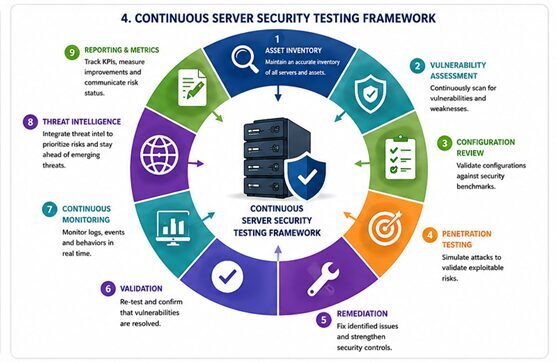
Building a Continuous Server Security Testing Strategy
Effective Server Security Testing is not achieved through isolated assessments but through an ongoing security program that continuously validates infrastructure resilience.
Organizations should begin by maintaining an accurate inventory of every server, virtual machine, cloud workload, and administrative interface. Once assets have been identified, automated vulnerability assessments should be performed regularly to detect newly disclosed vulnerabilities and configuration weaknesses.
Configuration reviews should verify compliance with secure baselines, while penetration testing validates whether identified weaknesses can be successfully exploited under realistic conditions.
Administrative access should be reviewed periodically to ensure permissions remain aligned with current business responsibilities. Security monitoring platforms should continuously analyze authentication events, configuration changes, privilege escalation attempts, and administrative activities to detect anomalous behavior.
Finally, organizations should measure the effectiveness of their testing program through meaningful metrics such as remediation time, vulnerability recurrence, privileged account exposure, configuration compliance rates, and security control validation results.
A continuous testing strategy transforms security from a reactive process into a proactive capability that identifies weaknesses before adversaries exploit them.
Conclusion
Server Security Testing is an essential component of modern cybersecurity strategy. As enterprise infrastructures become increasingly distributed across on-premises environments, cloud platforms, and hybrid architectures, organizations must continuously validate that their security controls remain effective against evolving threats.
Comprehensive testing extends far beyond vulnerability scanning. It encompasses configuration assessments, authentication validation, access control reviews, penetration testing, privilege escalation analysis, network service evaluation, and continuous monitoring. Together, these activities provide organizations with a comprehensive understanding of their security posture while enabling informed risk management decisions.
By adopting continuous Server Security Testing as an operational discipline rather than a periodic compliance exercise, organizations can reduce attack surfaces, strengthen resilience, improve regulatory compliance, and significantly increase the difficulty attackers face when attempting to compromise critical infrastructure.
Frequently Asked Questions (FAQ)
What is Server Security Testing?
Server Security Testing is the process of evaluating servers for vulnerabilities, security misconfigurations, weak authentication mechanisms, excessive privileges, and other weaknesses that could compromise the confidentiality, integrity, or availability of enterprise systems.
How often should servers be tested?
Critical production servers should undergo continuous vulnerability assessments, periodic configuration reviews, and regular penetration testing. Testing frequency should align with organizational risk tolerance, infrastructure changes, and applicable regulatory requirements.
What is the difference between Vulnerability Assessment and Penetration Testing?
A vulnerability assessment identifies known security weaknesses across systems, while penetration testing attempts to exploit those weaknesses to determine their real-world impact and validate the effectiveness of existing security controls.
Why is Server Hardening important?
Server hardening reduces the attack surface by disabling unnecessary services, applying secure configurations, enforcing strong authentication, restricting administrative access, and implementing security best practices based on recognized industry standards.
Which compliance frameworks recommend Server Security Testing?
Frameworks including ISO 27001, NIST Cybersecurity Framework, CIS Controls, PCI DSS, HIPAA, and SOC 2 all emphasize regular security assessments, vulnerability management, configuration validation, and continuous monitoring as essential components of an effective cybersecurity program.