
Protect cloud and on-premise environments with centralized security monitoring, threat detection, and vulnerability management from a single managed security service.

Hybrid cloud security is the practice of protecting servers and data that run partly in public clouds such as AWS, Azure, OCI or GCP and partly in your own data centre or private cloud, with one consistent set of controls. The aim is simple: every server gets the same hardening, patching, monitoring and response, wherever it runs, so attackers can’t use the weakest environment as a way in.
001.

Different security policies and tools across cloud and on-premise environments can create visibility gaps and increase risk.
002.

Managing infrastructure across multiple platforms introduces additional vulnerabilities that attackers can exploit.
003.

Security teams often struggle to gain a unified view of threats, vulnerabilities, and security events across hybrid infrastructures.
MaxProtect delivers continuous visibility, threat detection, vulnerability management, and security monitoring across your hybrid cloud environment, helping organizations safeguard workloads from evolving cyber threats.
Continuous monitoring and expert analysis help detect and investigate suspicious activity across your entire hybrid infrastructure.
Identify unauthorized access attempts, malware activity, privilege escalation, and indicators of compromise before they impact operations.
Discover security weaknesses across cloud workloads, Linux servers, Windows Server, virtual machines, and on-premise systems.
Correlate security events across environments while implementing security best practices to reduce attack surfaces.
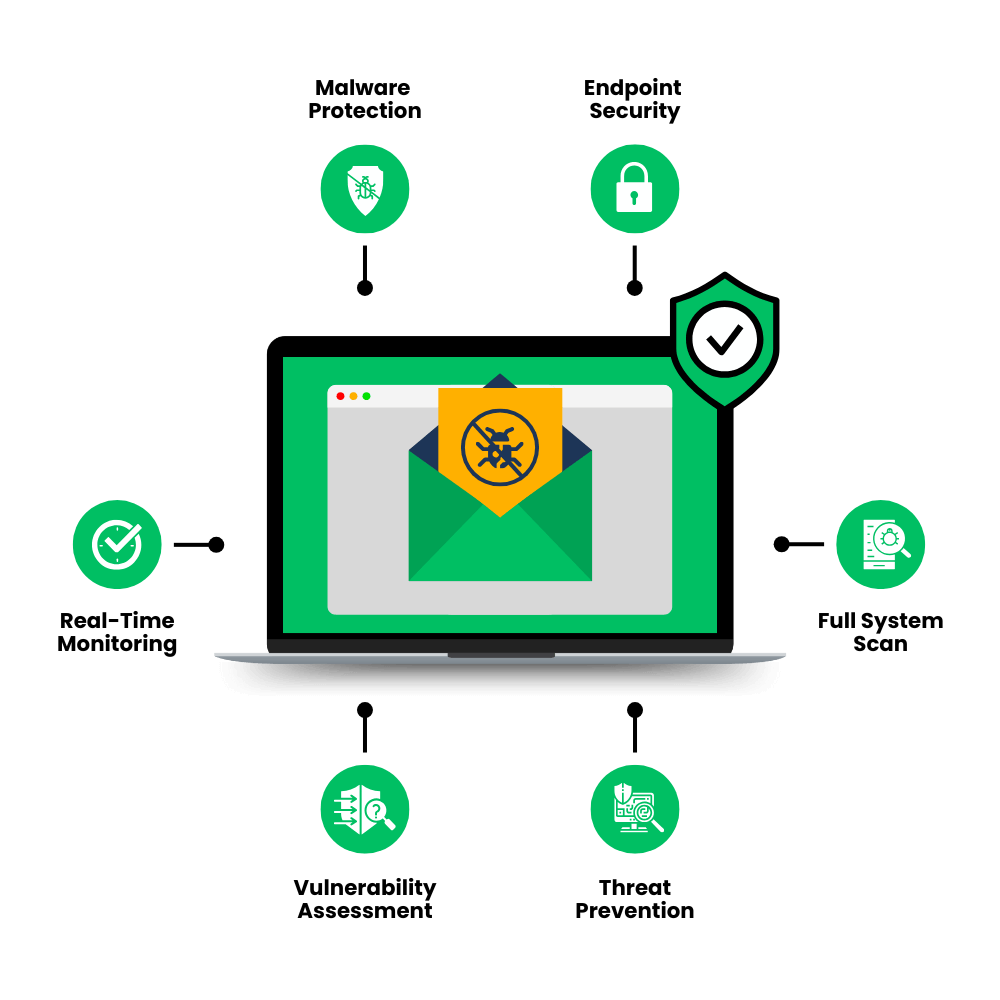
Protect critical systems with advanced endpoint security designed to detect and block malicious activity.
We provide a detailed monthly report showing exactly what we blocked, what we patched, and the current health of your infrastructure.

Most hybrid environments grow one project at a time, so each environment ends up with its own tools, its own patch routine and its own blind spots. MaxProtect replaces that patchwork with one service that works the same way on every server:
The plan covers on-premise servers and servers in OCI, AWS, Azure, GCP, DigitalOcean, Alibaba Cloud and other clouds, at the same $100 per server per month.
Here’s what that looks like in practice:
Most cloud security providers focus primarily on cloud platforms.
MaxProtect focuses on the operating systems and workloads attackers actually target.
Our team specializes in Server security monitoring, vulnerability management, endpoint protection, and security operations for cloud-hosted infrastructure.
A security plan that fits your business size and protection requirements.
Includes:
Identify security gaps, uncover vulnerabilities, and discover how MaxProtect can improve your hybrid cloud security posture.
⚠️ Audit Eligibility: This audit is specifically designed for Dedicated Servers, VPS, or Cloud Instances. We cannot perform audits on “Shared Hosting” accounts unless you are the owner/administrator of the entire physical or virtual server.
The document outlines actionable mitigation strategies and technical recommendations to strengthen defenses against unauthorized access and cyber threats.
It’s a way to protect servers that run across public clouds and your own data centre with one consistent set of controls and one team watching them. MaxProtect does this as a managed service: the same endpoint agent, hardening, patching, 24/7 SOC monitoring and monthly report on every server, whether it’s on-premise or in AWS, Azure, OCI, GCP or another cloud.
Yes. Our $100 per server per month plan works the same for on-premise servers and for servers in OCI, AWS, Azure, GCP, DigitalOcean, Alibaba Cloud and other clouds. Every server gets the same protection, and everything appears in one monthly report.
Yes. Our human-led SOC reviews anomalous system events and Active Directory logs, filtering out false alarms so we can act on real threats. That matters in hybrid setups, where on-premise Active Directory often controls access to cloud servers too.
Windows Server and Linux, including Ubuntu, CentOS, RHEL and AlmaLinux, with workloads such as Active Directory, IIS, SQL Server, Docker, Kubernetes and custom applications. We work on dedicated servers, VPS, private cloud VMs and public cloud instances, but not on shared hosting accounts.
Request a free external assessment. It needs no credentials, works on cloud instances and dedicated servers, and gives you a PDF report of open ports, exposed services and priority fixes across the systems you include.