
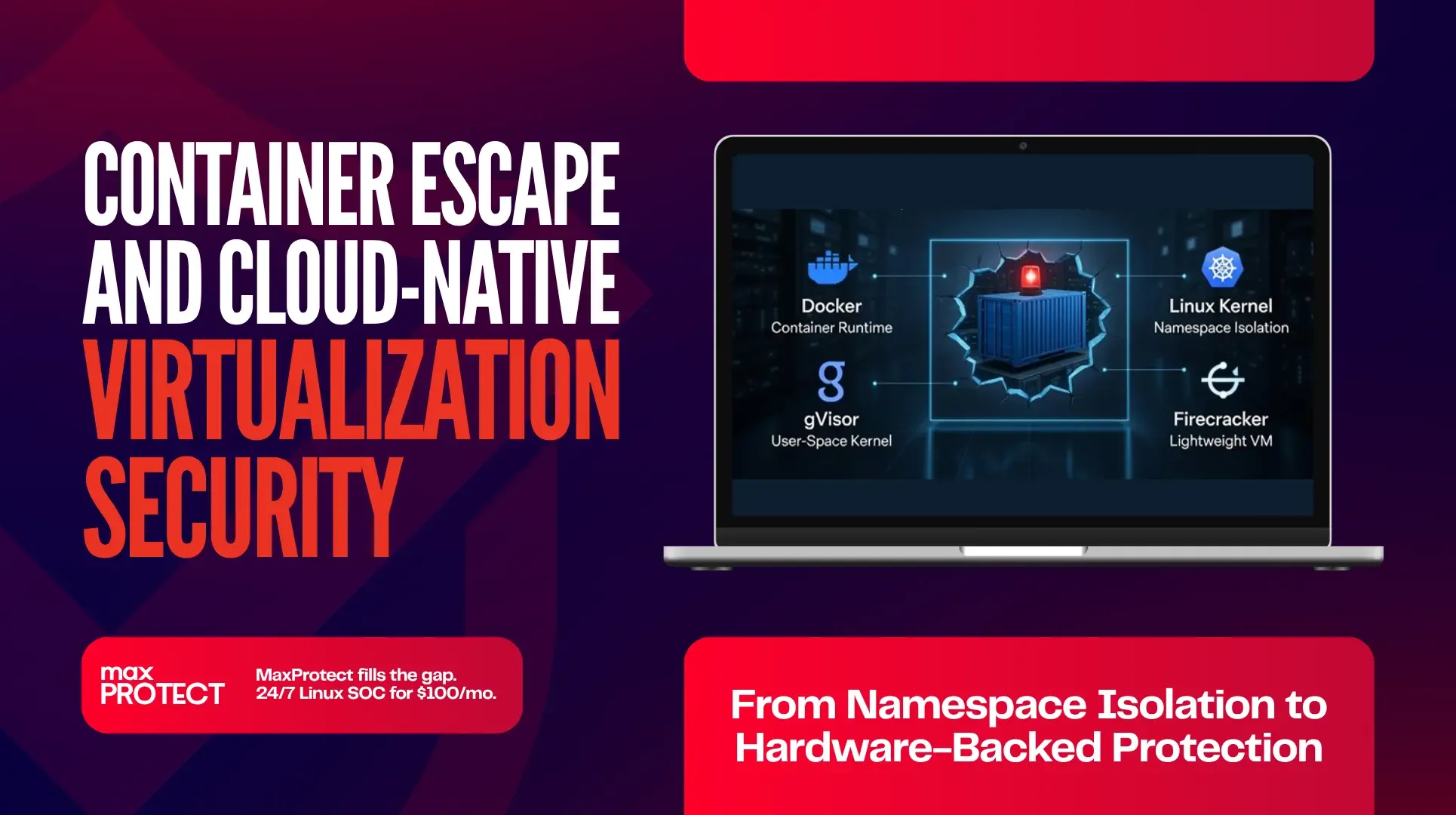
In this blog, we will explore the nature of container escapes in cloud-native environments, their root causes, the systems at risk, and the real-world consequences of these vulnerabilities. We will also cover how to audit your systems, immediate remediation steps, and long-term security best practices.
As enterprises increasingly adopt Docker, Kubernetes, and other container orchestration platforms, the reliance on shared-kernel architectures has grown significantly. While these technologies deliver exceptional efficiency, density, and scalability, they introduce unique security challenges. The Linux kernel’s namespaces, cgroups, and seccomp mechanisms provide process-level isolation, but they do not offer the same hardware-enforced boundaries as traditional virtual machines.
This article examines the technical foundations of container isolation, prominent escape vectors including the “Attack of the Vsock” (CVE-2025-21756), and strategies to transition toward more robust, hardware-backed security models suitable for multi-tenant cloud platforms.
The Fundamentals of Linux Container Isolation
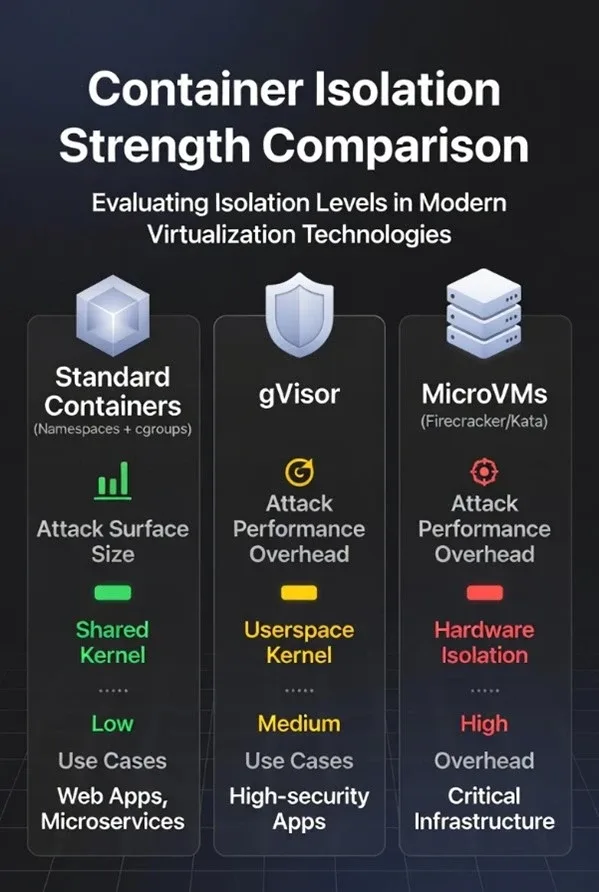
The Linux kernel utilizes namespaces to partition resources such that one set of processes operates in isolation from others. Key namespaces include:
- PID namespace: Provides process isolation.
- Mount namespace: Isolates filesystem views.
- Network namespace: Separates network stacks.
- User namespace: Maps container UIDs/GIDs to host values.
- UTS, IPC, and Cgroup namespaces: Handle hostname, inter-process communication, and resource controls.
Complementing namespaces are cgroups for resource limiting and seccomp for syscall filtering. Tools like Docker and containerd leverage these primitives through the Open Container Initiative (OCI) runtime specification, with runc as the default low-level runtime.
Despite these controls, shared-kernel designs mean that a vulnerability in the host kernel or runtime can potentially allow a compromised container to affect the host or neighboring containers. This shared responsibility model demands continuous evaluation of isolation limits.
Common Container Escape Vectors
Container escapes typically exploit one or more of the following:
- Runtime Misconfigurations: Mounting sensitive host paths (e.g., /var/run/docker.sock, /proc, or host filesystem volumes) grants containers undue privileges. A container with access to the Docker socket can spawn new privileged containers on the host.
- Kernel Vulnerabilities: Flaws like Dirty COW (CVE-2016-5195), Dirty Pipe (CVE-2022-0847), or io_uring issues allow privilege escalation within the kernel, bypassing namespace boundaries.
- Runtime Exploits: Recent examples include multiple runc vulnerabilities disclosed in late 2025 (e.g., CVE-2025-31133, CVE-2025-52565), which abuse maskedPaths, mount races, and procfs redirects to achieve host file writes or arbitrary code execution.
- Capability Abuse: Granting CAP_SYS_ADMIN, CAP_NET_ADMIN, or other powerful Linux capabilities expands the attack surface dramatically.
These vectors highlight that basic namespace isolation, while effective for many workloads, falls short against determined adversaries in high-stakes multi-tenant environments.
The “Attack of the Vsock” – CVE-2025-21756
A notable example is CVE-2025-21756, a use-after-free vulnerability in the Linux kernel’s vsock (virtual socket) subsystem. Vsock facilitates efficient communication between virtual machines and their hosts, commonly used in cloud virtualization stacks, Firecracker-based environments, and certain Kubernetes setups with virtualized networking.
The vulnerability stems from improper reference counting during transport reassignment in the vsock implementation. An attacker inside a guest environment can manipulate socket bindings and reference counters, leading to a use-after-free condition. This enables memory corruption primitives that sophisticated actors can chain into privilege escalation and host compromise.
Technical Impact:
- Affects kernels exposing vsock interfaces.
- Particularly relevant in virtualized container platforms where guests interact with host services via vsock.
- Allows breakout from isolated guest environments into the host machine.
- Demonstrates how virtualization-aware kernel features can become attack surfaces when not perfectly isolated.
Exploits for this CVE have been publicly discussed, underscoring the need for prompt patching and restricted exposure of vsock endpoints in production.
In cloud-native setups, attackers who gain initial foothold in a container or lightweight VM can leverage such flaws for lateral movement across tenants.
Kubernetes-Specific Risks
Kubernetes amplifies these challenges through its control plane and pod orchestration:
- Pod Security Contexts: Overly permissive securityContext settings, hostPath volumes, or privileged pods reduce isolation.
- Kubelet and Runtime Integration: The kubelet process and container runtime (containerd, CRI-O) manage many containers on a shared node. A breakout on one pod can impact the node.
- Service Accounts and RBAC: Overly broad permissions allow pods to create DaemonSets or other pods with elevated access.
- Network Policies and CNI: Misconfigurations can enable pod-to-pod or pod-to-host communication that bypasses intended boundaries.
Real-world incidents and proof-of-concepts demonstrate pod escapes via log mounts, volume subpath traversals, and runtime races.
Transitioning to Stronger Isolation Models
Organizations must evolve beyond basic namespaces. Two prominent approaches stand out:
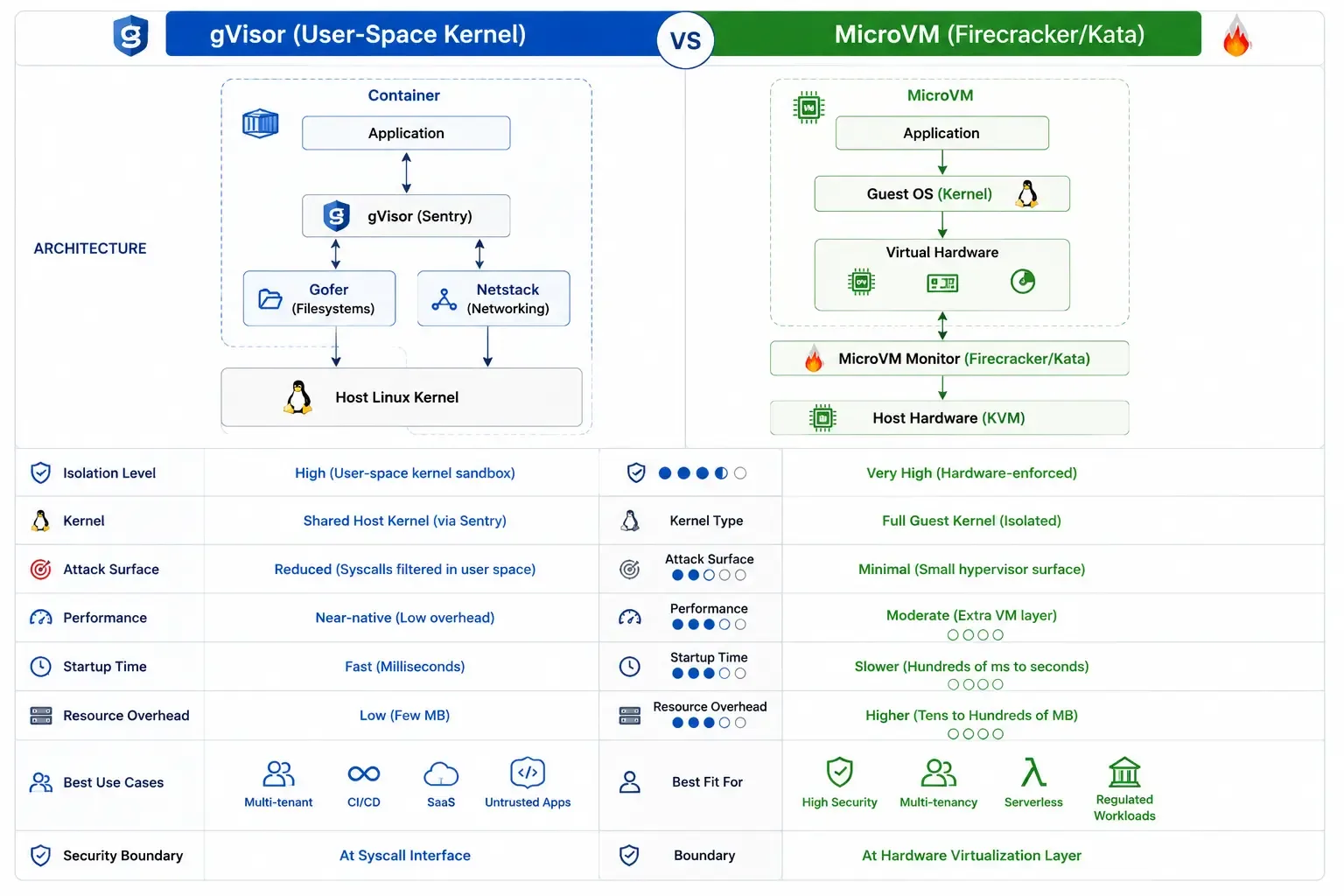
gVisor: User-Space Kernel Isolation
gVisor implements a lightweight, memory-safe kernel in Go (Sentry) that intercepts syscalls from the application container. It runs the workload in a sandboxed process, translating operations to the host kernel via a limited interface (Gofer for filesystem).
Advantages:
- Significantly reduces the attack surface exposed to the host kernel.
- Strong compatibility with existing container images.
- Lower overhead than full VMs for many workloads.
- Suitable for multi-tenant SaaS and CI/CD pipelines.
gVisor can operate in syscall trap mode or with KVM hardware acceleration for enhanced boundaries.
MicroVMs and Hardware-Backed Isolation
Technologies like Firecracker (used by AWS Lambda and Firecracker-based Kubernetes), Kata Containers, and Amazon Firecracker provide each workload with its own lightweight virtual machine backed by hardware virtualization (KVM/VT-x).
Key Benefits:
- Full guest kernel per workload.
- Hardware-enforced memory and execution isolation.
- Minimal hypervisor attack surface.
- Excellent for untrusted or high-security workloads.
While microVMs incur higher resource overhead and slower cold starts compared to native containers, they eliminate entire classes of kernel-based escapes.
Hybrid models using gVisor for most workloads and microVMs for sensitive ones offer practical balance.
Auditing Your Container Environment
Effective auditing requires systematic assessment:
- Image Scanning: Use tools like Trivy, Grype, or Anchore to detect vulnerabilities in base images and dependencies.
- Runtime Configuration Checks: Tools such as kube-bench, CIS Docker Benchmark, and Falco for anomaly detection.
- Kernel and Runtime Patching: Regularly update host kernels and runtimes (runc, containerd).
- Privilege Review: Audit for privileged containers, host mounts, and excessive capabilities using kubectl get pods –all-namespaces -o yaml | grep -E ‘privileged|hostPath’.
- Network and Access Controls: Verify network policies, RBAC, and Pod Security Admission (PSA) enforcement.
Implement continuous monitoring with eBPF-based tools like Cilium Tetragon or Sysdig for runtime threat detection.
Immediate Remediation Steps
- Patch Promptly: Apply kernel updates addressing CVE-2025-21756 and related runc CVEs. Restrict vsock exposure where possible.
- Enforce Pod Security Standards: Adopt the “Restricted” profile in Kubernetes.
- Drop Capabilities: Use securityContext.capabilities.drop: [“ALL”] and add only required ones.
- Disable Privileged Mode: Avoid privileged: true in production.
- Immutable Infrastructure: Use read-only root filesystems and immutable node images.
- Secrets Management: Integrate external secret stores (e.g., HashiCorp Vault, AWS Secrets Manager) instead of mounting secrets directly.
Long-Term Security Best Practices
- Shift-Left Security: Integrate scanning, signing (cosign), and policy enforcement (Kyverno, OPA/Gatekeeper) in CI/CD pipelines.
- Least Privilege Everywhere: Apply the principle at image build, runtime, and orchestration layers.
- Defense-in-Depth: Combine namespaces, seccomp/AppArmor/SELinux profiles, network policies, and runtime sandboxes.
- Zero-Trust Architecture: Assume breach; implement micro-segmentation and continuous verification.
- Monitoring and Incident Response: Deploy runtime security platforms capable of detecting anomalous syscalls or file accesses indicative of escape attempts.
- Hardware and Hypervisor Enhancements: Leverage confidential computing (e.g., AMD SEV, Intel TDX) for advanced use cases.
For Linux security professionals, staying informed about kernel CVEs and testing isolation boundaries through red-team exercises remains essential.
The Road Ahead for Cloud-Native Security
The evolution from namespace-based isolation to hardware-backed and user-space kernel models reflects the maturing understanding of container threats. While shared-kernel architectures will continue powering the majority of workloads due to their efficiency, critical and multi-tenant environments benefit from layered defenses that incorporate microVMs or gVisor.
By treating containers as untrusted by default and investing in robust isolation, organizations can realize the full benefits of cloud-native architectures without compromising security.
The Linux security community continues to advance these boundaries through projects like gVisor, Kata Containers, and ongoing kernel hardening. Proactive adoption of these technologies positions enterprises to securely scale their containerized infrastructures.