
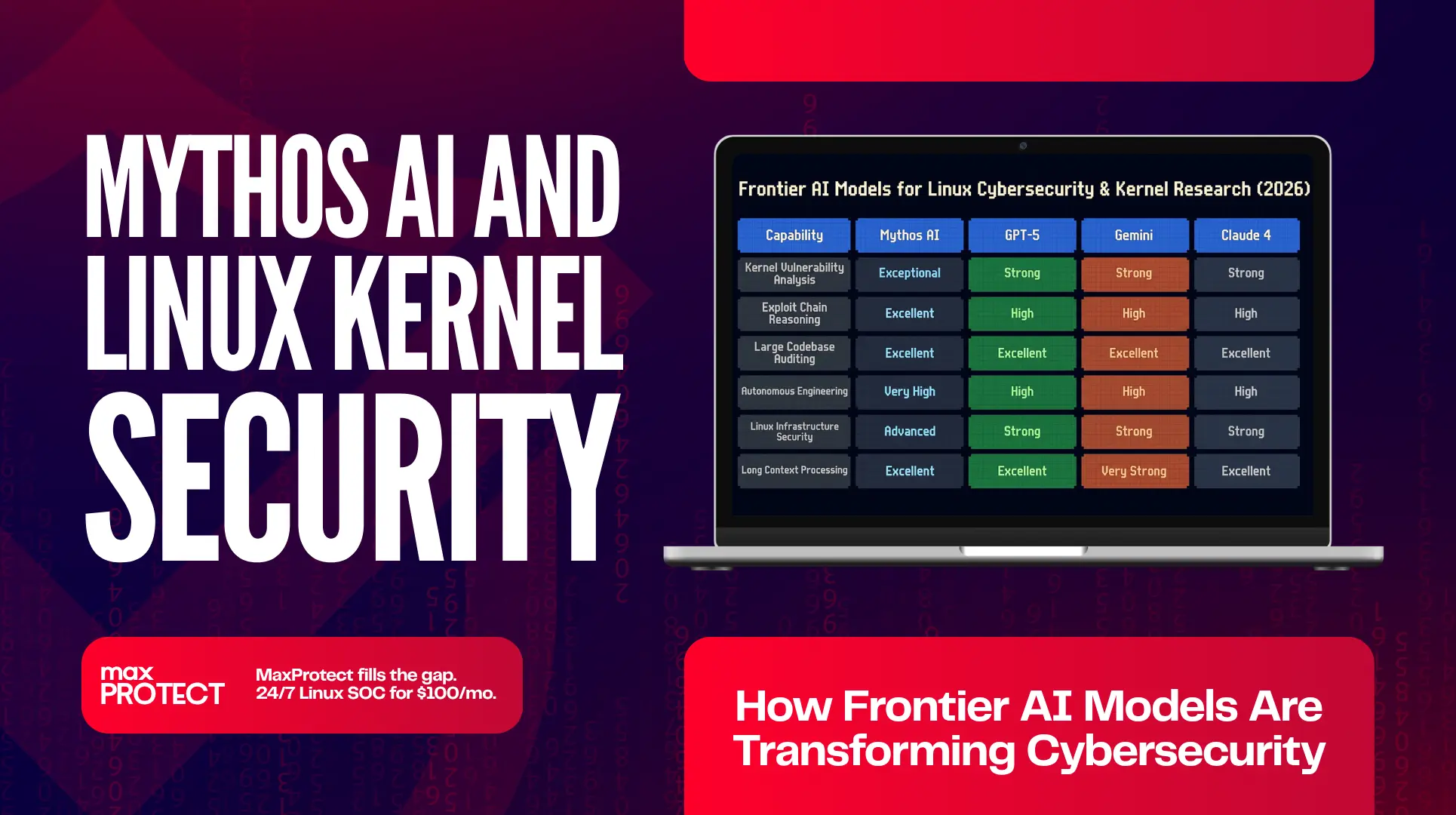
Artificial intelligence is rapidly reshaping the cybersecurity industry, but its most disruptive impact is now emerging within Linux infrastructure security and kernel-level vulnerability research. As organizations increasingly rely on Linux-powered cloud infrastructure, container orchestration platforms, and enterprise servers, advanced AI systems are beginning to redefine how vulnerabilities are discovered, analyzed, and exploited.
One of the most discussed developments in this space is Mythos AI, a frontier reasoning model associated with Anthropic’s next-generation AI research initiatives. Unlike traditional AI assistants focused primarily on text generation or productivity tasks, Mythos AI is reportedly designed for complex engineering workflows, autonomous technical reasoning, and large-scale code analysis.
For Linux security professionals, this evolution is highly significant.
Modern Linux environments contain millions of lines of interconnected kernel code responsible for process scheduling, memory management, privilege separation, networking, filesystem handling, and virtualization. Historically, identifying subtle vulnerabilities inside these systems required elite researchers with years of low-level systems experience.
Frontier AI models are changing that landscape entirely.
Why Linux Systems Are a Prime Target
Linux powers the majority of the modern internet. Cloud providers, Kubernetes clusters, enterprise servers, virtualization environments, and DevOps infrastructure all rely heavily on Linux-based systems. This makes Linux one of the most valuable targets for both defensive and offensive cybersecurity operations.
Kernel-level vulnerabilities are particularly dangerous because they operate at the core of the operating system itself. Successful exploitation can allow attackers to gain root-level access, bypass container isolation, disable security tooling, or persist below user-space visibility.
Historically, finding these vulnerabilities required manual auditing, reverse engineering, fuzzing, and extensive exploit development experience. AI-assisted cybersecurity workflows now accelerate many of these processes dramatically.
Mythos AI and Advanced Code Reasoning
One of Mythos AI’s most important capabilities is advanced software reasoning across large-scale codebases. Instead of analyzing isolated functions manually, the model can potentially evaluate entire repositories, identify dangerous interactions between subsystems, and trace privilege transitions automatically.
For Linux security researchers, this introduces a powerful new capability for identifying:
- Use-after-free vulnerabilities
- Race conditions
- Memory corruption flaws
- Reference counting weaknesses
- Unsafe syscall interactions
- eBPF abuse opportunities
- io_uring attack surfaces
- Namespace escape paths
- Privilege escalation vectors
The Linux kernel is extraordinarily complex, and many vulnerabilities emerge only through subtle interactions between multiple components. AI systems designed for large-context reasoning may identify patterns that are difficult for humans to detect manually.
AI-Driven Vulnerability Discovery in the Linux Kernel
Modern Linux kernels contain millions of lines of code distributed across networking subsystems, filesystems, device drivers, memory management modules, and process isolation mechanisms.
This complexity creates an enormous attack surface.
AI-assisted security research enables automated analysis of:
- Filesystem privilege boundaries
- Page cache interactions
- Container runtime isolation
- Kernel heap operations
- Scheduler logic
- Virtual memory behavior
- Driver communication interfaces
- Privileged execution paths
Frontier AI systems may dramatically reduce the time required to identify exploitable conditions.
For example, vulnerabilities similar to Dirty Pipe, Dirty COW, or advanced eBPF exploitation chains may become easier to discover through AI-assisted auditing techniques.
This creates both extraordinary defensive opportunities and significant offensive risks.
Autonomous Exploit Chaining and AI-Assisted Attacks
One of the most concerning developments in frontier AI research is automated exploit chaining.
A single low-severity Linux vulnerability may not appear dangerous in isolation. However, advanced AI systems can potentially combine multiple weaknesses into a coordinated attack chain.
A hypothetical AI-assisted Linux attack chain could involve:
- Information disclosure from a vulnerable driver
- Namespace isolation bypass
- Kernel heap manipulation
- Privilege escalation through memory corruption
- Persistence using malicious kernel modules
This type of multi-stage reasoning is exceptionally difficult manually but aligns closely with the strengths of advanced reasoning models like Mythos AI.
As these systems evolve, offensive cyber operations may increasingly occur at machine speed.
Linux Infrastructure Most at Risk
Cloud Infrastructure
Linux dominates modern cloud infrastructure. Public cloud environments, virtual machines, Kubernetes clusters, and containerized applications all rely heavily on Linux systems.
Attackers targeting cloud infrastructure may attempt to exploit:
- Kubernetes control planes
- Container runtimes
- Hypervisors
- CI/CD pipelines
- Shared kernel resources
- Identity and access systems
AI-assisted vulnerability research may significantly increase pressure on cloud security teams.
Enterprise Linux Servers
Enterprise distributions such as Ubuntu, Debian, Red Hat Enterprise Linux, Rocky Linux, and SUSE Linux remain critical targets due to their widespread deployment across government and enterprise infrastructure.
High-value targets include:
- Authentication systems
- Privileged binaries
- Remote access services
- Web application backends
- API infrastructure
- Logging systems
Software Supply Chains
Modern software ecosystems rely heavily on open-source packages and interconnected dependencies.
A vulnerability in a widely used Linux library or container image may cascade across thousands of downstream systems simultaneously.
AI systems capable of dependency analysis and large-scale repository auditing may dramatically increase both vulnerability discovery and remediation speed.
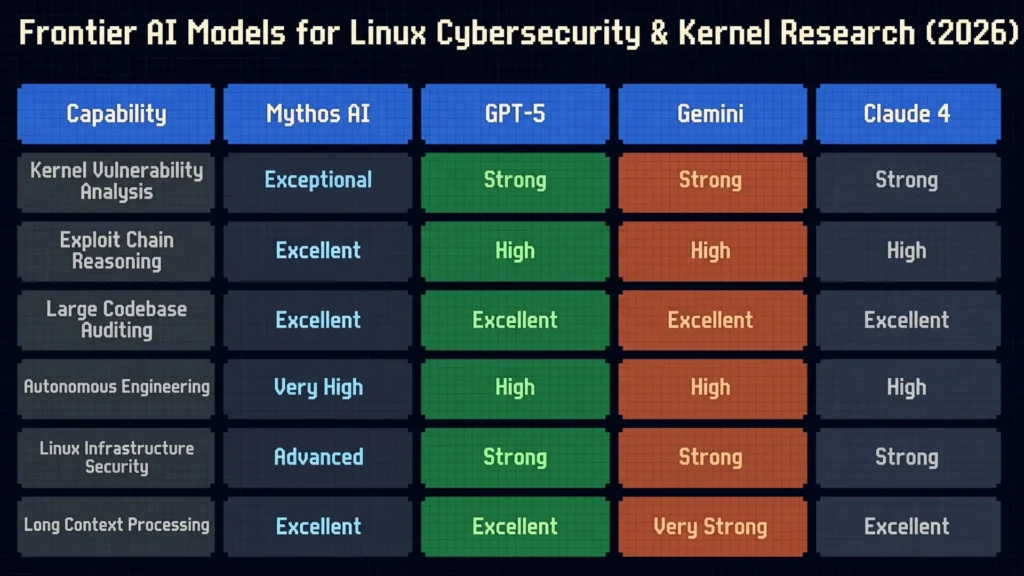
Mythos AI vs GPT-5, Gemini, and Claude 4
The frontier AI ecosystem is becoming increasingly competitive, especially within cybersecurity and software engineering domains.
Mythos AI is reportedly optimized for:
- Long-context reasoning
- Autonomous technical workflows
- Advanced software engineering
- Large-scale code auditing
- Complex vulnerability analysis
Compared with models such as GPT-5, Gemini, and Claude 4, Mythos appears particularly suited for Linux kernel analysis and exploit chain reasoning.
Its strength lies not simply in text generation but in sustained technical reasoning across interconnected systems.
This makes it especially relevant for:
- Linux kernel auditing
- Infrastructure security analysis
- Reverse engineering
- Threat modeling
- Security operations automation
- Vulnerability research workflows
Defensive Advantages for Security Teams
Despite the risks, frontier AI systems also provide substantial defensive advantages.
Organizations can use AI-powered cybersecurity tooling to:
- Audit Linux infrastructure continuously
- Analyze attack surfaces
- Detect insecure configurations
- Review kernel modules
- Simulate exploit paths
- Prioritize remediation efforts
- Monitor suspicious behavior
- Analyze runtime telemetry
This enables a transition from reactive security toward proactive AI-assisted defense.
Instead of waiting for attackers to discover vulnerabilities first, organizations can increasingly identify weaknesses internally before exploitation occurs.
Linux Hardening Strategies for the AI Era
As AI-assisted offensive capabilities continue evolving, Linux security teams must strengthen defensive controls immediately.
Recommended strategies include:
Aggressive Kernel Patch Management
Organizations should prioritize rapid patch deployment for:
- Linux kernels
- Container runtimes
- Virtualization platforms
- Authentication systems
- Privileged services
Shorter patch cycles are becoming increasingly important as AI accelerates vulnerability discovery.
Restrict eBPF and Privileged Interfaces
eBPF introduces powerful observability and networking capabilities, but also expands the kernel attack surface.
Security teams should:
- Restrict unnecessary eBPF access
- Enforce capability limitations
- Monitor suspicious eBPF activity
- Harden privileged interfaces
Enforce Least Privilege
Least-privilege enforcement remains one of the most effective defensive strategies.
Organizations should:
- Audit sudo permissions
- Limit privileged binaries
- Segment administrative access
- Reduce unnecessary services
- Harden authentication systems
Improve Runtime Visibility
AI-assisted attackers may operate rapidly and adaptively.
Organizations should implement:
- Centralized logging
- Runtime threat detection
- Kernel telemetry monitoring
- Container behavior analysis
- Network segmentation
- Continuous anomaly detection
Visibility is critical for detecting advanced attacks early.
The Future of AI and Linux Cybersecurity
The cybersecurity industry is entering a new era defined by AI-augmented operations.
Frontier AI systems capable of autonomous reasoning, large-scale code analysis, and vulnerability discovery may fundamentally reshape both offensive and defensive cybersecurity practices.
Linux environments are likely to remain one of the most important battlegrounds because they power cloud infrastructure, enterprise systems, container ecosystems, and critical internet services worldwide.
Organizations that proactively modernize security operations, adopt AI-assisted defensive tooling, and strengthen Linux hardening practices will be significantly better positioned for the future.
The rise of Mythos AI highlights a critical reality for modern cybersecurity professionals:
The future of Linux security will increasingly involve defending systems not only against human attackers but against intelligent autonomous systems capable of operating at machine speed.