

Modern enterprises depend heavily on Microsoft Active Directory (AD) to manage identities, authenticate users, authorize access, and enforce security policies across Windows environments. At the heart of this infrastructure lies the Domain Controller (DC)—the system responsible for maintaining the integrity and availability of an organization’s authentication services.
Because Domain Controllers store sensitive identity information, security policies, password hashes, Kerberos tickets, and trust relationships, they are among the highest-value targets for cybercriminals. A successful compromise of a Domain Controller can provide attackers with administrative control over an entire Windows enterprise, allowing them to manipulate user accounts, deploy malware, exfiltrate sensitive information, or disrupt business operations.
In this blog, we will examine why Domain Controllers are critical to enterprise security, explore the most common attack techniques used against Active Directory, discuss the business risks associated with Domain Controller compromise, and provide practical guidance for hardening, monitoring, and protecting these essential systems.

What is a Domain Controller?
A Domain Controller is a Windows Server that hosts Active Directory Domain Services (AD DS). It authenticates users and computers, enforces Group Policy Objects (GPOs), manages security principals, and stores the Active Directory database.
Every authentication request within a Windows domain typically involves communication with a Domain Controller. Whether a user signs into a workstation, accesses a shared file server, joins a device to the domain, or requests access to enterprise applications, the Domain Controller validates credentials and determines authorization based on configured security policies.
Core responsibilities include:
- Authenticating users and devices
- Managing user and group accounts
- Storing Active Directory objects
- Enforcing Group Policies
- Issuing Kerberos tickets
- Replicating directory information across Domain Controllers
- Managing trust relationships between domains
Because every identity-related operation depends on Domain Controllers, they form the foundation of enterprise identity security.
Why Domain Controllers Are Critical Assets
Unlike standard servers that host individual applications, Domain Controllers govern access to nearly every system connected to the domain.
A compromised workstation may affect a single employee. A compromised application server may expose one service. However, a compromised Domain Controller can enable attackers to gain privileged access across the entire enterprise.
The Active Directory database contains:
- User accounts
- Computer accounts
- Security groups
- Password hashes
- Kerberos keys
- Service Principal Names (SPNs)
- Group Policy configurations
- Organizational Units (OUs)
- Domain trust information
- Certificate Services integration
This concentration of sensitive identity data makes Domain Controllers a primary objective during ransomware campaigns, insider threats, and advanced persistent attacks (APTs).
How Active Directory Authentication Works
Understanding authentication helps explain why Domain Controllers are so attractive to attackers.
A typical authentication process follows these steps:
- A user enters their credentials.
- The workstation contacts the Domain Controller.
- The Domain Controller validates the credentials.
- Kerberos authentication is initiated.
- A Ticket Granting Ticket (TGT) is issued.
- Service tickets are generated as users access network resources.
- Access permissions are evaluated using security groups and access control lists.
Because every authentication request depends on trust established by the Domain Controller, compromising this system enables attackers to manipulate the authentication process itself.
Why Attackers Target Domain Controllers
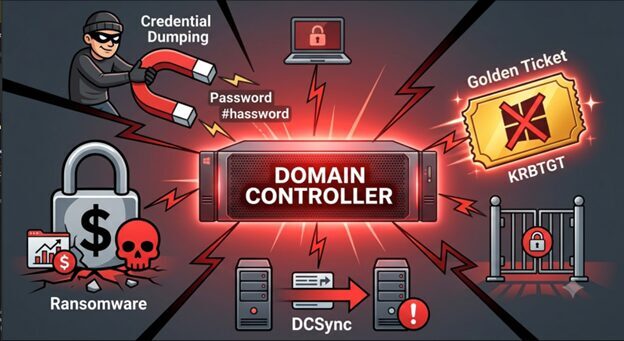
Threat actors rarely stop after compromising a single endpoint. Their objective is typically to escalate privileges, move laterally, and obtain administrative control over the domain.
Domain Controllers provide several advantages to attackers:
- Complete visibility of enterprise identities
- Centralized authentication control
- Access to privileged credentials
- Ability to create or modify administrator accounts
- Deployment of malicious Group Policies
- Distribution of malware across the network
- Persistence through Active Directory modifications
Modern ransomware groups routinely target Domain Controllers before encrypting systems because domain-wide administrative privileges significantly accelerate enterprise-wide attacks.
Common Threats Against Domain Controllers
Credential Dumping
Credential dumping involves extracting password hashes, Kerberos tickets, or authentication secrets from memory or security databases.
Attackers commonly target:
- LSASS memory
- dit database
- SAM database
- Cached credentials
These credentials can then be reused to authenticate without knowing plaintext passwords.
Pass-the-Hash (PtH)
Pass-the-Hash allows attackers to authenticate using stolen NTLM password hashes instead of plaintext passwords.
Once administrative hashes are obtained, attackers can move laterally between systems without cracking passwords.
This technique remains effective in environments where NTLM authentication is still enabled.
Pass-the-Ticket (PtT)
Kerberos authentication relies on tickets rather than passwords.
Attackers who steal valid Kerberos tickets can reuse them to access enterprise resources until the tickets expire.
Because authentication appears legitimate, Pass-the-Ticket attacks are often difficult to detect.
Kerberoasting
Service accounts configured with Service Principal Names (SPNs) receive Kerberos service tickets encrypted using their passwords.
Attackers request these tickets, extract them, and perform offline password cracking.
Weak service account passwords remain one of the leading causes of successful Kerberoasting attacks.
DCSync Attack
DCSync is one of the most dangerous Active Directory attacks.
Instead of compromising the Domain Controller directly, attackers abuse directory replication privileges.
The attacker impersonates a Domain Controller and requests password hashes from Active Directory replication.
If successful, they can retrieve password hashes for every user in the domain, including Domain Administrators.
Golden Ticket Attack
Golden Ticket attacks involve forging Kerberos Ticket Granting Tickets using the KRBTGT account hash.
Once attackers possess the KRBTGT hash, they can generate valid authentication tickets for any account within the domain.
These forged tickets may remain valid until the KRBTGT password is reset twice.
Silver Ticket Attack
Unlike Golden Tickets, Silver Tickets target individual services rather than the entire domain.
Attackers forge service tickets that allow access to specific resources without contacting the Domain Controller.
This reduces logging visibility and complicates detection.
DCShadow Attack
DCShadow enables attackers to register rogue Domain Controllers temporarily.
The malicious server injects unauthorized changes into Active Directory replication.
Attackers can create privileged accounts, modify permissions, or establish persistence while generating minimal forensic evidence.
Ransomware Targeting Active Directory
Modern ransomware operations frequently prioritize Active Directory before encrypting endpoints.
Attackers may:
- Disable security software
- Create privileged accounts
- Push malicious Group Policies
- Delete backups
- Modify administrative permissions
- Disable recovery mechanisms
Compromising Domain Controllers significantly increases the speed and impact of ransomware deployment.
Indicators of Domain Controller Compromise
Security teams should investigate:
- Unexpected Domain Administrator account creation
- Unauthorized Group Policy modifications
- Replication requests from unusual systems
- Large authentication failures
- Privileged logins during non-business hours
- Sudden changes to privileged groups
- Unusual Kerberos ticket activity
- Unexpected replication events
- Changes to trust relationships
- Access to NTDS.dit
No single indicator confirms compromise, but correlated events often reveal malicious activity.
Business Impact of a Domain Controller Breach
A compromised Domain Controller affects more than IT operations.
Potential consequences include:
- Enterprise-wide authentication failures
- Loss of privileged credentials
- Complete identity compromise
- Data theft
- Regulatory violations
- Extended operational downtime
- Financial losses
- Reputation damage
- Ransomware deployment
- Long-term attacker persistence
Because Active Directory supports nearly every Windows-based business service, recovering from a Domain Controller compromise often requires rebuilding trust across the environment.
Domain Controller Hardening Best Practices
A layered security strategy significantly reduces the attack surface.
Use Dedicated Domain Controllers
Avoid installing additional applications on Domain Controllers.
These systems should perform only identity-related functions.
Implement Least Privilege
Administrative privileges should be limited to personnel who require them.
Avoid permanent Domain Admin memberships.
Use Just-In-Time (JIT) or Privileged Access Management where possible.
Enable Multi-Factor Authentication
Administrative accounts should require MFA.
MFA reduces the effectiveness of stolen passwords and phishing attacks.
Secure Administrative Workstations
Administrators should manage Domain Controllers only from hardened Privileged Access Workstations (PAWs).
Avoid logging into Domain Controllers from standard user devices.
Keep Systems Updated
Regularly install:
- Windows security updates
- Active Directory patches
- Kerberos fixes
- LDAP security updates
Unpatched Domain Controllers remain vulnerable to publicly known exploits.
Disable Legacy Authentication
Reduce reliance on:
- NTLMv1
- SMBv1
- Unsigned LDAP
- Weak encryption protocols
Modern authentication mechanisms provide stronger protection.
Protect the KRBTGT Account
Reset the KRBTGT password after confirmed compromise.
This invalidates forged Kerberos tickets generated during Golden Ticket attacks.
Monitor Privileged Groups
Continuously monitor changes involving:
- Domain Admins
- Enterprise Admins
- Schema Admins
- Administrators
- Account Operators
Unexpected privilege escalation often indicates malicious activity.
Monitoring Domain Controllers
Continuous monitoring is essential for detecting suspicious activity.
Key Windows Security Events include:
| Event ID | Description |
| 4624 | Successful Logon |
| 4625 | Failed Logon |
| 4672 | Special Privileges Assigned |
| 4720 | User Account Created |
| 4728 | User Added to Security Group |
| 4732 | Member Added to Local Group |
| 4768 | Kerberos Authentication Request |
| 4769 | Kerberos Service Ticket Request |
| 4771 | Kerberos Pre-Authentication Failed |
| 5136 | Active Directory Object Modified |
These events should be collected into a centralized SIEM platform for correlation and alerting.
Backup and Recovery

Even well-protected environments require reliable recovery strategies.
Organizations should:
- Perform regular System State backups
- Protect backup repositories from ransomware
- Test Active Directory restoration procedures
- Document recovery runbooks
- Maintain offline backup copies
Recovery planning minimizes downtime following catastrophic incidents.
Security Best Practices Checklist

Organizations should regularly verify that they have implemented the following controls:
- Harden Domain Controllers using Microsoft security baselines.
- Enable multi-factor authentication for privileged accounts.
- Restrict administrative access through Privileged Access Workstations.
- Continuously monitor Active Directory events.
- Audit privileged group memberships.
- Apply security updates promptly.
- Disable legacy authentication protocols.
- Secure backup infrastructure.
- Protect service account credentials.
- Review Group Policy changes regularly.
- Perform periodic Active Directory security assessments.
- Conduct penetration testing against Active Directory environments.
Conclusion
Domain Controllers represent the foundation of identity and access management within Windows enterprises. Their ability to authenticate users, enforce security policies, and manage privileged access makes them indispensable—but also one of the most valuable targets for cyber attackers.
As attack techniques continue to evolve, organizations must move beyond perimeter-focused defenses and prioritize the protection of their Active Directory infrastructure. A comprehensive security strategy should combine system hardening, least-privilege administration, continuous monitoring, timely patch management, privileged access controls, and regular security assessments.
By treating Domain Controllers as Tier 0 assets and implementing defense-in-depth practices, organizations can significantly reduce the likelihood of compromise, improve resilience against modern cyber threats, and maintain the integrity of their enterprise identity infrastructure.