
Linux has earned a reputation as one of the most secure operating systems in the world. It powers cloud infrastructure, enterprise applications, web hosting environments, financial systems, and mission-critical workloads across industries. Its stability, flexibility, and security-focused architecture have made it the operating system of choice for organizations that require reliability at scale.
However, security professionals know an important truth: no operating system is immune to cyber threats.
As Linux adoption continues to grow, attackers are increasingly developing malware, ransomware, the rise of supply chain attacks targeting Linux (such as the infamous XZ Utils backdoor discovered in 2024) or ransomware groups explicitly targeting Linux-based hypervisors (like ESXi) and intrusion techniques specifically designed to target Linux-based environments. Modern threat actors are no longer looking for easy targets; they are pursuing high-value infrastructure that often runs on Linux. Whether it’s a cloud server hosting sensitive customer data, a Kubernetes cluster running production workloads, or a database server supporting critical business operations, Linux systems have become attractive targets for cybercriminals.
The challenge facing organizations today is not simply preventing attacks. The real challenge is identifying malicious activity before attackers can establish persistence, move laterally through networks, or exfiltrate valuable information.
This is where Linux Security Monitoring Tools play a critical role. Continuous monitoring provides visibility into system activity, user behavior, file changes, and network communications, enabling organizations to detect threats before they become security incidents. Instead of reacting after a breach occurs, businesses can adopt a proactive security posture that identifies suspicious behavior in real time.
In this guide, we’ll explore how Linux security monitoring works, why it has become a necessity for modern organizations, and which tools can help security teams stay ahead of evolving threats.
Why Traditional Linux Security Is No Longer Enough
For years, organizations relied on a combination of firewalls, antivirus solutions, patch management, and periodic security audits to protect Linux systems. While these controls remain important, they are no longer sufficient against modern cyber threats.
Today’s attackers are patient. Rather than launching noisy attacks that immediately attract attention, many adversaries focus on remaining hidden for as long as possible. A compromised account can quietly access sensitive files. A malicious process can blend into normal system activity. An attacker can establish persistence mechanisms that survive system reboots and software updates.
The danger lies in the time between compromise and detection.
Security studies consistently show that organizations often take days, weeks, or even months to identify a successful intrusion. During this period, attackers can escalate privileges, gather intelligence, steal data, and expand their access across the environment.
Without continuous monitoring, security teams may have little visibility into these activities until the damage has already been done.
Modern Linux security requires organizations to continuously monitor authentication events, system logs, process execution, network activity, file modifications, and user behavior. Visibility is no longer optional; it is a fundamental requirement for effective cybersecurity.
How Continuous Linux Security Monitoring Works
Continuous security monitoring involves collecting and analyzing data from Linux systems in real time. Every action performed on a server leaves a digital footprint. Login attempts, file modifications, process execution, network connections, and privilege changes all generate valuable security data.
Monitoring platforms aggregate this information and analyze it for indicators of compromise.
For example, if an administrator account suddenly begins logging in from an unusual geographic location, the monitoring system can generate an alert. Similarly, if critical system files are modified unexpectedly or a server initiates communication with a known malicious IP address, security teams can investigate immediately.
This proactive approach enables organizations to identify threats early in the attack lifecycle, reducing the likelihood of significant business impact.
Rather than relying solely on signatures and known malware indicators, modern Linux Security Monitoring Services often incorporate behavioral analytics, threat intelligence feeds, and machine learning to identify suspicious patterns that traditional security controls may miss.
The Evolution of Observability: eBPF
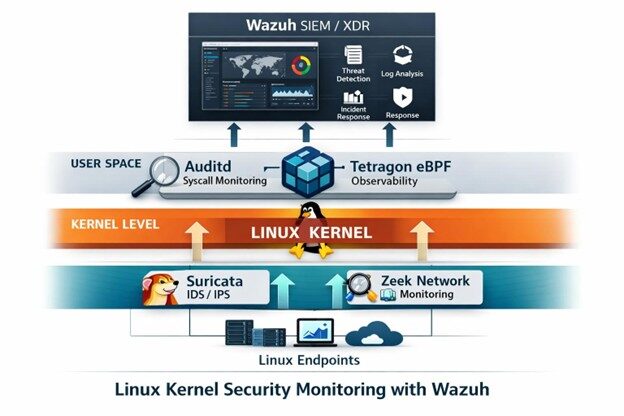
A major shift in modern Linux security is the adoption of eBPF (Extended Berkeley Packet Filter). Historically, monitoring tools required loading heavy kernel modules, which risked crashing production servers, or relying on user-space auditing which could be bypassed by advanced malware. eBPF allows security tools to safely run sandboxed programs directly inside the Linux kernel. This grants deep, un-bypassable visibility into system calls, network packets, and process lifecycles in real time, all with negligible performance overhead.
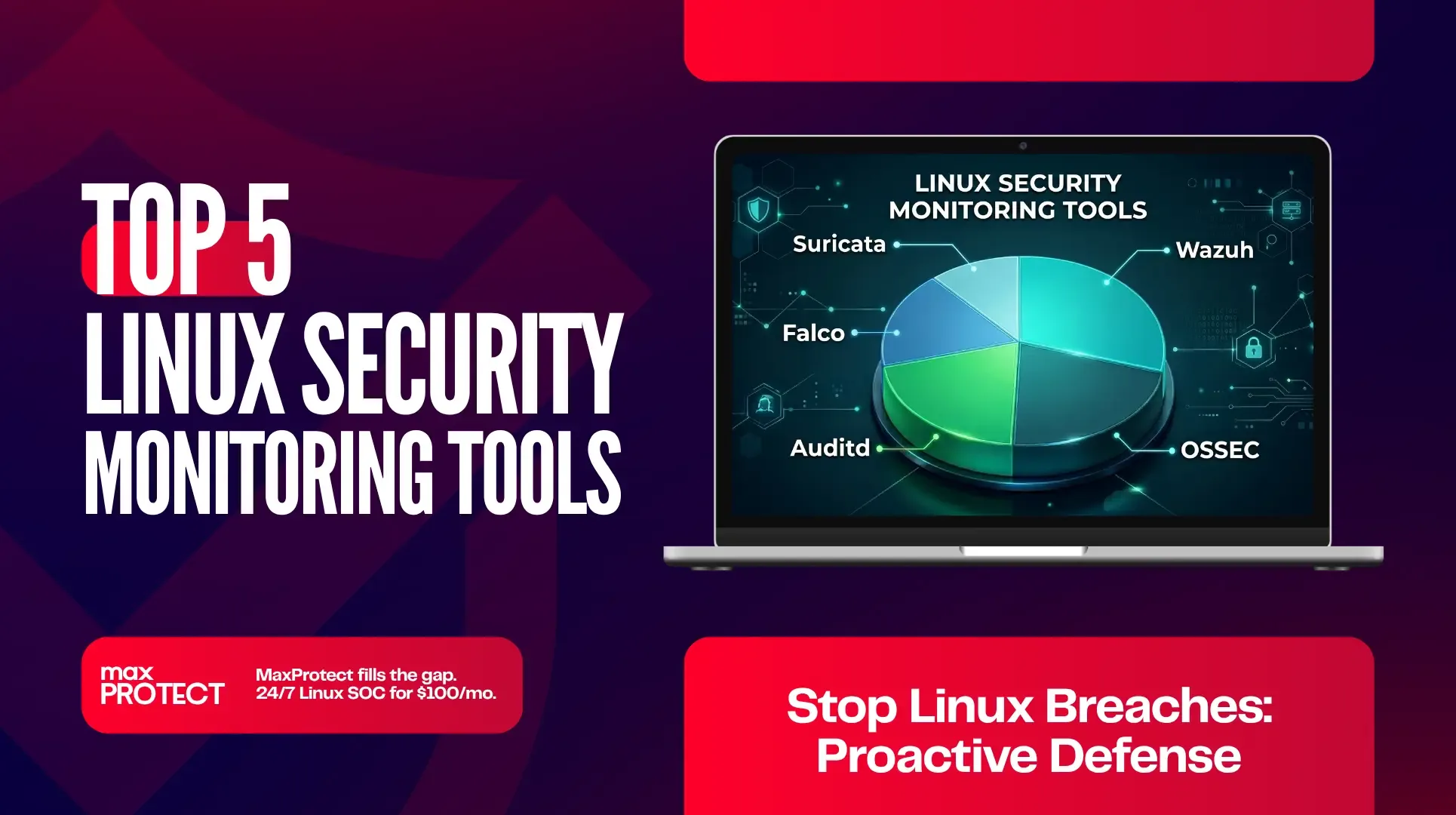
Top 5 Linux Security Monitoring Tools You Need in Your Tech Stack Right Now
Technology plays a central role in effective monitoring. While no single solution can address every security challenge, several tools have become industry favorites because of their visibility, flexibility, and detection capabilities.
Wazuh
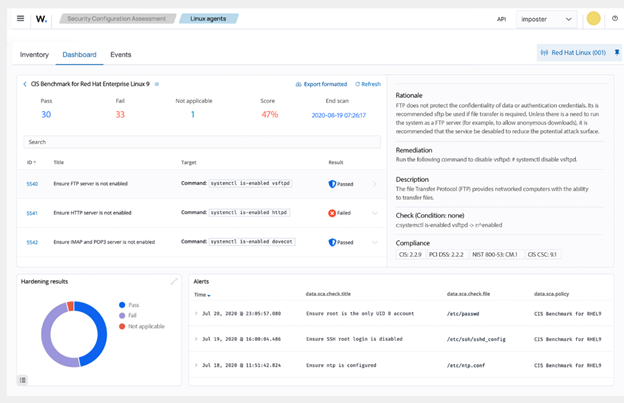
Wazuh has emerged as one of the most widely adopted open-source security monitoring platforms. It provides host-based intrusion detection, file integrity monitoring, vulnerability assessment, and compliance reporting within a single platform.
Organizations appreciate Wazuh because it combines powerful detection capabilities with a user-friendly dashboard. Security teams can quickly identify unauthorized changes, suspicious user activity, and potential malware infections across large Linux environments.
For organizations building a Security Operations Center (SOC), Wazuh often serves as a foundational component of their monitoring strategy.
- Best For: Comprehensive open-source SIEM/XDR and centralized security analytics.
- Key Feature: Combines powerful threat detection with automated compliance mapping (PCI-DSS, HIPAA) on a unified dashboard.
- Architecture Type: Host-based (Agent/Manager architecture).
OSSEC
OSSEC remains one of the most respected host-based intrusion detection systems available. Despite being lightweight, it offers extensive capabilities for log analysis, rootkit detection, policy monitoring, and active response.
Many organizations deploy OSSEC to monitor critical Linux servers where performance and stability are essential. Its ability to detect file changes and suspicious system activity makes it particularly valuable for compliance-driven environments.
- Best For: Lightweight, low-overhead monitoring on legacy or resource-constrained servers.
- Key Feature: Excellent file integrity monitoring (FIM) and real-time log analysis engines.
- Architecture Type: Host-based.
Auditd
Auditd is the native Linux auditing framework and remains an essential tool for many security professionals.
Unlike third-party monitoring solutions, Auditd provides deep visibility into system-level activity. Security teams can track user actions, monitor privileged commands, and investigate security incidents with detailed forensic data.
For organizations subject to regulatory requirements, Auditd often serves as a critical source of audit logs and compliance evidence.
- Best For: Core system forensics, compliance auditing, and tracking raw system calls.
- Key Feature: Tracks user actions, privileged commands (like sudo), and system calls directly from the kernel interface.
- Architecture Type: Host-based (Native Linux subsystem).
Falco
As organizations increasingly adopt containers and Kubernetes, runtime security has become a major concern. Falco addresses this challenge by monitoring workloads in real time and detecting suspicious activity within containerized environments.
Falco can identify unauthorized shell access, privilege escalation attempts, unexpected process execution, and other behaviors that may indicate compromise.
Its cloud-native design makes it particularly valuable for DevOps and DevSecOps teams operating modern infrastructure.
- Best For: Container, Kubernetes, and cloud-native runtime security.
- Key Feature: Leverages eBPF drivers to detect unauthorized shell access, privilege escalations, and unexpected container behaviors instantly.
- Architecture Type: Cloud-Native / Kernel-level.
Suricata
While endpoint monitoring is important, network visibility remains equally critical. Suricata provides advanced network intrusion detection and prevention capabilities, enabling organizations to inspect traffic for malicious behavior.
By analyzing network communications in real time, Suricata helps security teams identify malware activity, command-and-control communications, and suspicious outbound connections that may indicate data exfiltration.
When combined with host-based monitoring tools, Suricata provides a comprehensive security monitoring solution.
- Best For: High-performance network traffic analysis and threat detection.
- Key Feature: Deep packet inspection capabilities to catch command-and-control (C2) communications and data exfiltration.
- Architecture Type: Network-based (NIDS/NIPS).
Real-World Attack Scenario: How Monitoring Prevents a Breach
Imagine a Linux server hosting a customer-facing web application.
An attacker discovers a vulnerable plugin and successfully gains limited access to the system. From the attacker’s perspective, the next objective is to establish persistence and obtain elevated privileges.
The attacker begins executing reconnaissance commands like whoami and cat /etc/passwd to understand the environment. They then attempt to append a rogue user to the wheel group or inject an unauthorized key into /root/.ssh/authorized_keys.
Without monitoring, these activities could go unnoticed.
However, a properly configured Linux Security Monitoring Service immediately detects multiple indicators of suspicious behavior. The creation of a privileged account generates an alert. File integrity monitoring identifies unauthorized modifications to system configuration files. Behavioral analytics detect unusual command execution patterns.
Security analysts investigate the alerts within minutes and isolate the affected server before the attacker can expand access or exfiltrate data.
This scenario demonstrates the true value of monitoring. It does not merely identify attacks; it significantly reduces attacker dwell time and limits potential damage.
Building an Effective Linux Security Monitoring Service
Technology alone is not enough. Organizations must develop processes and operational procedures that support effective monitoring.
A successful monitoring strategy begins with visibility. Security teams should collect logs from Linux servers, applications, firewalls, cloud environments, and network devices. Centralizing this information enables analysts to correlate events and identify attack patterns that might otherwise go unnoticed.
Threat intelligence should also play a role in the monitoring process. By integrating intelligence feeds, organizations can identify known malicious IP addresses, suspicious domains, and emerging attack techniques more effectively.
Equally important is the development of incident response procedures. Monitoring generates value only when organizations know how to respond to alerts. Clear escalation paths, containment procedures, and investigation workflows ensure that threats are handled quickly and consistently.
Organizations that combine strong monitoring capabilities with mature operational processes are significantly better positioned to defend against modern cyber threats.
The Future of Linux Security Monitoring
Cybersecurity continues to evolve rapidly, and monitoring technologies are evolving alongside it.
Artificial intelligence and machine learning are increasingly being integrated into monitoring platforms to improve threat detection accuracy. Instead of relying solely on predefined rules, modern solutions can identify subtle anomalies that may indicate compromise.
Extended Detection and Response (XDR) platforms are also gaining popularity. These solutions combine endpoint, network, cloud, and identity monitoring into a unified platform, providing security teams with a broader view of their environment.
As organizations continue migrating workloads to cloud-native architectures, monitoring solutions must adapt to support containers, Kubernetes, serverless computing, and hybrid infrastructure environments.
The future of Linux security monitoring will focus on greater automation, faster response times, and improved visibility across increasingly complex environments.

Conclusion
Linux remains one of the most trusted operating systems in modern computing, but trust alone is not a security strategy. Attackers continuously search for vulnerabilities, stolen credentials, and misconfigurations that can provide access to valuable systems and data.
Organizations that rely solely on preventive controls risk discovering attacks only after significant damage has occurred. Continuous monitoring changes this equation by providing real-time visibility into system activity, enabling security teams to identify threats earlier and respond more effectively.
Whether through Wazuh, OSSEC, Auditd, Falco, Suricata, or a comprehensive Linux Security Monitoring Service, organizations that invest in proactive monitoring gain a significant advantage against modern cyber threats.
In today’s threat landscape, visibility is security. The sooner suspicious activity is detected, the greater the opportunity to stop a breach before it becomes a business crisis.